Upright, Bartop, Countertop or Tabletop? Arcade Cabinet Types Explained
Upright, cabaret, bartop, countertop, cocktail table, candy cab, pedestal, wall-mounted, mini: what each arcade cabinet type is, how big it is, and which current models belong to each one.
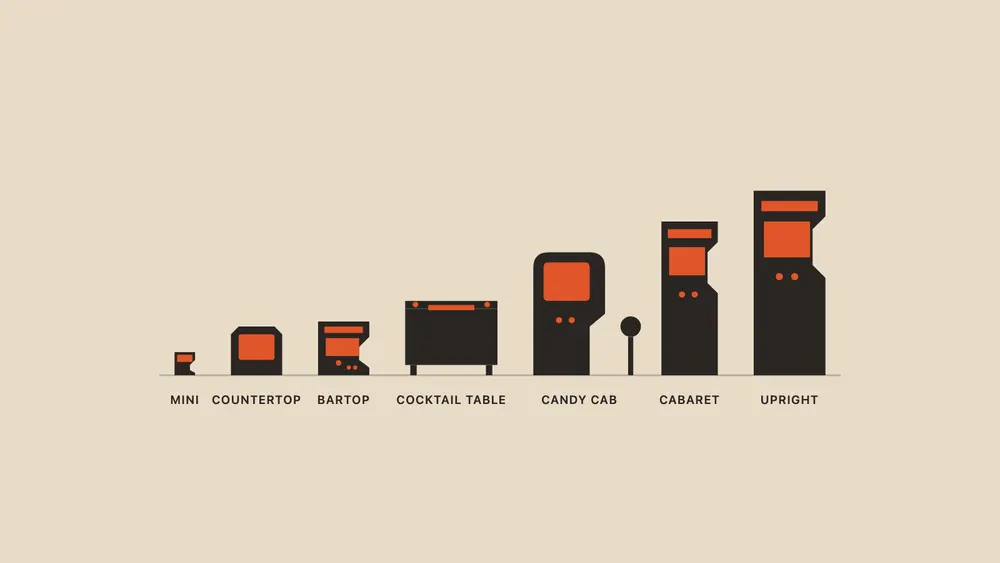
Listings for arcade machines all use the same handful of words: upright, stand-up, bartop, countertop, tabletop, cocktail, mini, pedestal. Sellers use them loosely, and the same product often appears under two or three of them, so it is easy to buy a "tabletop arcade" that turns out to be eight inches tall. This guide explains what each type is, how big it is, and which models on sale in 2026 belong to it, then covers the differences that matter more than the shape.
The main arcade cabinet types at a glance
Every arcade machine is a screen, a control panel and a box. The type is decided by where the box stands and how the player faces it.
| Type | Where it stands | Typical size | How you play |
|---|---|---|---|
| Upright (stand-up) | On the floor | About 6 ft tall; 4 to 5 ft for home replicas | Standing |
| Cabaret (mini upright) | On the floor | About 5 ft tall, narrower | Standing |
| Bartop | On a bar, table or riser | 16 to 24 in tall, 8 to 24 in screen | Joystick and buttons |
| Countertop | On a bar or counter | Bartop footprint, touchscreen | Touch, standing or seated |
| Cocktail table (tabletop) | On the floor, table height | About 29 in tall, screen faces up | Seated, players opposite |
| Sit-down / cockpit | On the floor | Includes the seat | Seated, often a wheel or yoke |
| Candy cab | On the floor | About 4 ft tall | Seated on a stool |
| Pedestal | On the floor, plays on your TV | Waist-high control stand | Standing |
| Wall-mounted | On the wall | About 42 in tall | Standing |
| Mini / desktop | On a desk or shelf | 7 to 17 in tall, 3 to 5 in screen | Scaled-down controls |
Prices and line-ups below are as the makers listed them in September 2026 and change often.
Upright (stand-up) cabinets
The upright is the original: a wooden box about six feet tall with the monitor at eye level, a control panel at waist height, a lit marquee and printed side art. A full-size original from the 1980s weighs 200 to 300 pounds. Most uprights sold for homes today are replicas at three-quarter scale, about four feet tall on a riser, with "deluxe" versions closer to five feet.


Popular upright models
- Arcade1Up Deluxe and Supreme ($599.99 and $799.99 in the autumn 2026 relaunch under Basic Fun): the highest-profile home upright line, flat-pack, a few licensed classics per cabinet.
- AtGames Legends Ultimate HD: a full 66 inches tall, 24-inch screen, two joysticks, spinners and a trackball, 300 licensed games built in. The Mini HD version is 61 inches with an 18-inch screen and 150 games.
- Bandai Namco Pac-Man's Pixel Bash Home Cabaret: a 60-inch commercial-grade cabinet from the arcade maker itself, 32 licensed Namco classics.
- Creative Arcades stand-up multicades: assembled in California, shipped built, three-year warranty.
Right for a dedicated game room or basement. Wrong for a living room or home bar, where the same money buys something that sits on the counter.
Cabaret cabinets, the original "mini"
A cabaret is a shrunken upright from the early 1980s, about five feet tall and 20 to 24 inches wide, built for locations where a full cabinet would not fit. Collectors like them because they go through doors and up stairs. The name survives in products such as the Pixel Bash Home Cabaret, and sellers also call three-quarter-scale replicas "mini uprights", so check the height in inches rather than trusting the label.

Bartop cabinets
Take an upright, cut it off below the control panel and stand what is left on a bar: that is a bartop. It keeps the joystick, buttons, marquee and side art but has no legs. Bartops run 16 to 24 inches tall with screens from 7 to 24 inches. The format grew up in bars, where operators wanted a video game without giving up a floor slot; JVL's own bartop line dates from 1995. At home, a bartop fits a bar, a kitchen island or a sideboard, usually played from a stool, and many makers sell a base that turns it into a floor-standing machine later.

Popular bartop models
- Arcade1Up Countercade and Countercade+ ($149.99 and $199.99): the entry point, three to five licensed games, small screens.
- SNK Neo Geo MVSX (by Unico): 17-inch 4:3 screen, two control sets, 50 licensed SNK games; about $450, or $500 with the base.
- Evercade Alpha (Blaze): an 8-inch bartop at about $250 with six built-in Capcom or Taito games and cartridge slots for more than 500 titles.
- Pandora's Box bartops: generic cabinets from many small sellers around a Chinese multicade board with thousands of emulated games; cheap and variable.
- Custom bartops from Creative Arcades, Doc and Pies Arcade Factory and Etsy builders, usually 19 to 24 inches of screen with a PC or Raspberry Pi inside.
Right for a den, dorm or home bar and a player who wants a stick in the hand. Finish quality varies widely across the category, so see one in person if it will be on display.
Countertop cabinets
Countertop is the coin-op industry's own word, and it means something narrower than it sounds. A countertop sits on a bar like a bartop, but it is built around a touchscreen rather than a joystick, for short casual games two people can trade turns on: cards, puzzles, trivia, word games, bar-sports classics. The format took over bar counters in the 1990s with Merit's Megatouch, which ran until production stopped in January 2014; JVL's own countertops of the same era, the Vortex and Retro iTouch lines, were touchscreen machines of the same kind and are still traded used.

The difference from a bartop is who plays it. A guest who has never held a joystick will still walk up to a touchscreen. The touchscreen also removes the parts most exposed to wear on any arcade machine, though it does not remove failure altogether. Arcade1Up's Countercade sounds similar but is a bartop: joystick, buttons, a handful of fixed games.
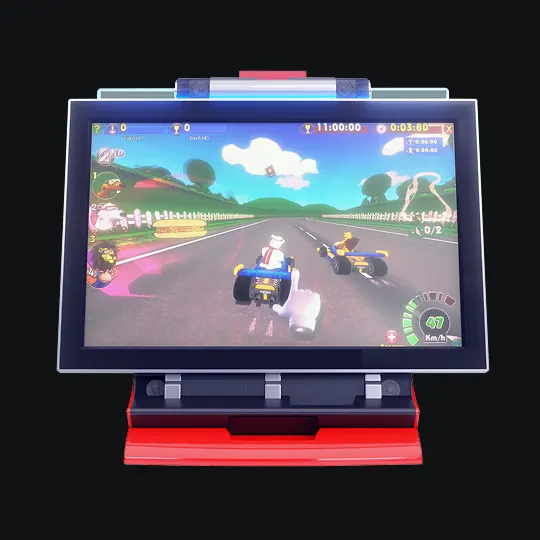
Countertop models, past and present
- Merit Megatouch (Force, Ion and Aurora series, 1990s to 2014): the machine that defined the category, now used-market only.
- JVL Vortex and Retro iTouch (2000s): JVL's earlier touchscreen countertops, also on the used market.
- JVL ECHO HD3: the current production countertop and the eleventh generation of a bartop line JVL has built since 1995. A 22-inch HD touchscreen, 149 built-in proprietary games, a 360° swivel base for head-to-head play, 15 × 19.5 × 18.5 inches at 39.4 pounds. The Home Edition lists at $3,990 as a free-play machine; the Commercial Edition, which adds payment hardware for venues, at $4,250. Both carry a one-year all-inclusive manufacturer warranty on the same terms.
Right for a home bar, kitchen or den where guests of different ages will play and card, puzzle and trivia games matter as much as action. Wrong for a fighting-game player who wants a stick. The bartop buying guide covers what to check on a premium countertop before buying.
Tabletop and cocktail cabinets
"Tabletop" is used for three different things. The original is the cocktail table: a coffee-table-height cabinet with the screen facing up through a glass top and a control panel at each end, so two players sit opposite each other and the picture flips for the second player's turn. Taito's cocktail version of Space Invaders in 1978 made it a fixture of cafés and pubs. The second meaning is the touchscreen game table, a flat screen in a table frame running digital board games. The third is the loosest: retailers tag any small bartop or desktop unit "tabletop" because it sits on a table. If a listing says tabletop, check whether the screen faces up or forward.

Popular tabletop and cocktail models
- Bandai Namco Pac-Man's Pixel Bash Cocktail Table: commercial-grade, 19-inch screen, tempered glass top, 32 licensed games.
- Arcade1Up Ms. Pac-Man Cocktail Table ($599.99, 12 games) and the bar-height Pub Table ($599.99, 10 games).
- Arcade1Up Infinity Game Table (32-inch) and Infinity Game Board (18.5-inch): touchscreen tables for up to six players, digital board games, Wi-Fi.
- Creative Arcades cocktail multicades: assembled, three-year warranty.
Right for a lounge or family room, and the only format built for two people to sit and face each other. Slower classic games suit it better than fighters.
Sit-down, candy cab and the newer formats
Sit-down and cockpit cabinets include the seat: a bench and wheel for driving games, a wrap-around cockpit, or a "deluxe" cabinet whose whole body moves with the game. Sega's 1986 Out Run deluxe and Atari's 1983 Star Wars cockpit are the famous ones. At home the format survives as racing simulators and seated cabinets for consoles, such as Rec Room Masters' Xtension Sit-Down.

Candy cabs are the Japanese answer to the upright: a moulded plastic cabinet played seated on a stool, with a 29-inch monitor, a low control panel and a standard harness for swapping game boards. Sega's Astro City (1993) and Blast City (1996) and Taito's Egret II (1996) are the best known. They are imported collector machines for people who already know which boards they want.

Pedestals are a control panel on a waist-high stand with no screen: they plug into the TV on the wall. Rec Room Masters' Xtension Pedestal is a long-running kit for PCs, Raspberry Pi and consoles. Wall-mounted cabinets hang like a television; Polycade's Sente is the best-known, a 24-inch screen in a 25.5-by-42-inch body at $2,199 without a computer or $2,499 with a mini PC.
Minis are scaled-down cabinets with tiny screens and real, if small, sticks, bought as much for the shelf as for play.

- Sega Astro City Mini (2020): 36 games, 4-inch screen, about $130.
- Taito Egret II Mini (2022): 40 games, 5-inch screen that rotates for vertical games, about $200.
- SNK Neo Geo Mini (2018): 40 games on a 3.5-inch screen, TV output.
- Numskull Quarter Arcades (quarter scale, about $160) and New Wave Toys RepliCade (sixth scale, about $120): licensed replicas of specific cabinets.
Which cabinet type fits which room
- Dedicated game room or basement: an upright, a candy cab or a cocktail table, depending on whether you want to stand, sit low or sit across from someone.
- Living room where the machine must pass as furniture: a cocktail table or a wall-mounted cabinet.
- Home bar, kitchen island or den: a bartop if you want a joystick, a countertop if you want a touchscreen and games any guest will play.
- Desk, shelf or gift budget: a mini.
- A TV you already own: a pedestal.
The touchscreen versus button controls comparison goes through the counter-format decision on its own.
Other differences that matter more than the shape
Two machines with the same silhouette can be completely different purchases. These are the axes that separate them.
By control type
- Joystick and buttons: the arcade default. Japanese-style parts (Sanwa, Seimitsu) have short, light throws and suit fighters; American-style parts (Happ) are stiffer and taller. Cheap bartops use unbranded copies of either.
- Trackball: a ball rolled under the palm, used by early-1980s games and by bar golf and bowling games; the AtGames Legends Ultimate builds one in.
- Spinner: a knob for games where something moves along one axis; also on the Legends Ultimate.
- Wheel and pedals, flight yoke, light gun: dedicated controls that tie a cabinet to one genre, typical of sit-down and deluxe cabinets.
- Touchscreen: the countertop's control. Nothing to learn and nothing mechanical on the panel to wear, at the cost of games that need a physical stick.
- Console pads and swappable decks: pedestals, wall cabinets and the AtGames and Rec Room Masters lines accept USB or Bluetooth controllers and interchangeable control panels.
By where the games come from
- Licensed classics: Arcade1Up, AtGames, Bandai Namco, the MVSX and Evercade pay for the specific titles they ship, which is why each cabinet carries a fixed list of three to a few hundred games and can show them on the cabinet art.
- In-house games: the countertop tradition. Megatouch's library was written for Megatouch, and the ECHO HD3's 149 games are JVL's own, built for a touchscreen and for two people trading turns.
- Emulation multicades: Pandora's Box boards and MAME cabinets run emulated copies of original arcade software rather than titles the maker ships under licence. A bartop advertised with "10,000 games" is this kind of machine; buyers who care should ask what rights the library is supplied under.
- Cartridges and online stores: Evercade expands by cartridge, AtGames through an online store and subscription. A store-based library depends on the company staying open: iiRcade owners lost access to their purchases when it went bankrupt and shut its servers in June 2023. How arcades get their games covers the licensing side.
By how it is built
- Fully assembled, commercial grade (Bandai Namco, JVL, Creative Arcades): the same construction sold to venues, heavy and priced accordingly. On JVL's line, assembling a unit takes hours, while the full cycle to a unit ready to ship runs up to seven working days of testing, burn-in, a second quality check and packing.
- Flat-pack self-assembly (Arcade1Up, AtGames): panels and a bag of screws, cheaper to ship, an evening of assembly for the buyer.
- Kits and shells (Rec Room Masters): a finished cabinet or kit that takes your own PC, Raspberry Pi or console.
- DIY from plans: a Raspberry Pi running RetroPie in an MDF box. The cheapest way to a bartop and the most work; the result is only as good as the builder's woodwork and wiring.
- Restored originals: 1980s cabinets bought through collector markets, with CRT monitors and 40-year-old boards that need someone able to service them.
By screen and players
- Aspect ratio: originals used 4:3 CRTs, often mounted vertically for shooters; new machines use LCDs, 4:3 on replicas and 16:9 on touch and modern-game cabinets.
- Rotating display: the Egret II Mini and the Legends Ultimate turn the screen for vertical games, the compromise for mixed libraries.
- Two players alternating: cocktail tables, where the picture flips for the second player.
- Two players side by side: uprights and bartops; a few home uprights take four.
- Head-to-head on one screen: a swivel base, as on the ECHO HD3, turns a countertop to whoever's turn it is.
By edition and connection
- Home edition: boots straight to free play, no payment hardware.
- Venue edition: the same machine with payment hardware and operator settings; a used ex-venue unit may ask for a credit until someone finds the free-play setting.
- Needs a network: cabinets whose store, leaderboards and updates run over Wi-Fi, such as the AtGames line.
- Works offline: machines with a built-in library, such as the ECHO HD3, run without a connection, which matters in a basement or a cabin.
Frequently asked questions
Is a bartop arcade the same as a countertop arcade?
No, though sellers mix the words. Both sit on a counter without legs. A bartop is a shortened upright with a joystick and buttons; a countertop, in the coin-op trade's usage, is a touchscreen machine for trivia, card, puzzle and other short games. If it has a stick, it is a bartop.
What is a tabletop arcade machine?
It depends on the listing. The traditional tabletop is a cocktail table with the screen facing up and players seated opposite each other. Retailers also use the word for small bartops and desktop minis, and for touchscreen game tables. Check whether the screen faces up or forward.
How tall is a full-size arcade cabinet?
A classic upright is about six feet tall, around 26 inches wide and 35 inches deep, and weighs 200 to 300 pounds. Home replicas are usually three-quarter scale, about four feet on a riser, with five-foot deluxe versions.
What is a candy cab?
A Japanese-style sit-down cabinet, usually white moulded plastic with a large monitor and a low control panel, played from a stool. Sega's Astro City and Blast City are the best-known examples.
Sources
12 sources- Wikipedia, Arcade cabinet (types, dimensions and control panel parts)
- The Toy Book, Basic Fun! Debuts New Arcade1Up Games at Toy Fair, February 2026
- AtGames, Legends Ultimate HD
Show 9 moreShow less
- Unico, SNK MVSX
- Time Extension, Review: Evercade Alpha
- Bandai Namco Pac-Man's Pixel Bash Cocktail Table (retailer listing)
- Arcade1Up, Cocktail Tables
- Polycade, Compare Lux & Sente
- Rec Room Masters, Xtension Sit Down Pedestal Arcade Machine
- Engadget, Taito's Egret II Mini is an arcade replica with a rotating screen
- Arcade Heroes, Newsbytes: iiRcade Bankruptcy, June 2023
- JVL, The Best Megatouch Alternative in 2026 (Megatouch history)