The Best Megatouch Alternative in 2026: What Happened to the Original, and What to Buy Now
Megatouch ended in January 2014, not in a 2008 collapse and not in bankruptcy. What really happened, used prices today, and the best alternative to buy.

Highlights
- Megatouch production ran to a shutdown announced on 7 January 2014 — it did not quietly end in 2008
- No bankruptcy ended the brand — its parent retired it and is still trading, so nobody revived it
- Used units ask anywhere from $300 to $2,700, with no manufacturer parts, updates or warranty behind them
- The format is still built new and the catalogue is not — a new ECHO HD3 lists at $3,990 or $4,250
Megatouch stopped being made in January 2014. Twelve years later people are still searching for one, and the search almost always ends the same way: an eBay listing, a machine that needs work, and no manufacturer to call.
Most of what gets written about the brand online is wrong in the same two places. It says Merit Industries went bankrupt, and it says the line died with the 2008 recession. Neither is what happened, and the real sequence changes what you should do about it.
This article sets out that sequence, what a used unit costs today, what breaks on one, and what to buy if you want the format rather than the badge.
What Megatouch actually was
Megatouch was a countertop touchscreen game built for bars. It sat in the rail, took quarters, and gave two people something to do between drinks without either of them leaving their stool.
The formula barely changed in twenty years, because it did not need to:
- A touchscreen in a countertop cabinet, 15 to 19 inches on most models
- Short games: poker, solitaire, trivia, puzzles, spot-the-difference
- A coin door and usually a bill acceptor, on a route split between the operator and the venue
- One or two players, reachable from a seat without standing up
Merit had been in this category a long time before the end. The closure notice credited the brand with leading the countertop coin-op video category for 35 years, and that is roughly the span from the first touchscreen units to the last.
Which Megatouch models had which screen size
Screen size moved with the line, which matters when you are reading a used listing and trying to work out what you are looking at. The figures below come from service documentation and current dealer listings, and configurations varied within each family.
| Model family | Screen | Roughly |
|---|---|---|
| XL and Maxx | 13" to 15", CRT then LCD | Late 1990s to mid 2000s |
| Force and EVO | 15", some 17" | Mid to late 2000s |
| ION, Aurora, wide-screen RX | 15", 17", 19", 20" | Around 2010 to 2013 |
| ML-1 (Megatouch Live) | 22" HD | 2013, the last one |
The pattern is worth noting before you shop. A machine described simply as "a Megatouch" could be anything from a 13-inch CRT to a 22-inch HD panel, and the two are twenty years apart in every respect.
Bars are proportional to screen diagonal. Configurations varied within each family, so a listing has to be read model by model.
What actually happened to Megatouch
No bankruptcy appears anywhere in this story, and the end came six years later than most accounts place it. Here is the sequence, and then what each step in it actually meant.
- 1970s Merit Industries builds coin-op amusement machines in Bensalem, Pennsylvania
- Mid-1990s The first Megatouch countertop touchscreens reach bars
- 2002 The Harbour Group acquires Merit Industries
- 2004 - 2009 Merit is combined with jukebox maker Rowe International and the group becomes AMI Entertainment Network - the published accounts date this differently
- 2008 Recession cuts route collections - but production continues[3], and this is where most accounts wrongly end the story
- 2011 - 2013 Force and ION software still ships. The ML-1 arrives in 2013 with a 22-inch HD screen, and Megatouch, LLC is spun off as its own entity
- 7 January 2014 Megatouch announces the end of all development and production of touchscreen terminals and software[3]
- 2014 - 2026 No successor from the original side. AMI Entertainment still trades, and the brand stays retired
The company changed hands before the games stopped
Merit Industries built Megatouch out of Bensalem, Pennsylvania, from the 1970s - published sources disagree on whether the company was founded in 1974 or 1977. The Harbour Group acquired Merit in 2002 and combined it with the jukebox maker Rowe International, and the combined business became AMI Entertainment Network.[1]
By the end, Megatouch was not an independent company at all. It was one product line inside a jukebox business. That is the fact most retellings leave out, and it explains everything that followed.
A product line inside a larger group lives or dies on how it compares with the other lines. Megatouch was competing for investment against jukeboxes and change machines, in a group with a clear view of where venue money was going.
Production did not stop in 2008
The 2008 downturn hurt, and it hurt in the way that matters most to this business. Bar traffic fell, route collections fell with it, and a model built on coin drop had no cushion for a long recession.
But new hardware kept coming for another five years. Force and ION software carried 2011 dates. The Aurora and the wide-screen RX ran through the early 2010s. The final model, the ML-1, was copyrighted in 2013 and shipped with a 22-inch HD screen, online leaderboards and player accounts.[3]
The line was still launching new hardware in the year before it was cancelled. Any account that has Megatouch quietly expiring in 2008 is describing a decline that did not happen on that schedule.
The shutdown, and why nobody bought the brand
Megatouch, LLC had been spun into its own entity in 2013. On 7 January 2014 it announced it was ceasing all development and production of touchscreen terminals and associated software.[3] Trade coverage at the time noted that the parent's other divisions, jukeboxes and change machines among them, would carry on normally.
The announcement said warranty and parts support would continue for a period. It did not say anyone would keep building the machines, and nobody did.
No bankruptcy filing appears anywhere in the record. The parent is still trading: AMI Entertainment sells jukeboxes, music video and narrowcast TV to tens of thousands of venues today.
A brand that fails gets bought. A brand retired by a healthy owner stays retired. That is why twelve years of nostalgia have produced no revival, no licensing deal and no successor from the original side.
Why the whole category went quiet
Megatouch did not lose to a competitor. The conditions that made a countertop touchscreen worth a quarter came apart at once:
- Touch stopped being novel once every pocket held a touchscreen
- Free mobile games competed directly with a quarter-a-play trivia round
- Route economics tightened, and operators stopped placing new units
- Nobody else moved in, because the segment looked finished rather than open
The last point shaped the decade that followed. The demand never went away, but for years there was nothing new to buy.
What a used Megatouch costs in 2026
The used market never went away either. Machines from 2007 through 2014 still surface weekly, and for some buyers a vintage unit is the point rather than a compromise.
What a used Megatouch sells for
| What you find | Asking price |
|---|---|
| Classic XL, Maxx, Force and EVO cabinets | $300 to $1,000 |
| Later ION, Aurora, RX and VIBE units | $1,500 to $2,700 |
| Dealer machines, serviced and tested before shipping | $1,200 to $2,250 |
Seventeen whole machines listed in eBay's video arcade category on 3 September 2026.[6] The figures mix fixed asking prices with live auction bids, and an opening bid is not a sale price, so the floor here reflects where these cabinets actually change hands. Condition varies enormously, and "working" in a private listing often means it powered on once, in a garage, months ago.
Dealer prices sit higher for a reason. A dealer has usually tested the unit, replaced whatever failed the test, and will answer the phone in week two.
The hidden costs of used hardware
The asking price is rarely the number that matters. What lands on top of it, in rough order of how often it comes up:
- Touchscreen sensors and film, the part that most often ends a machine
- Hard drives holding fifteen-year-old software with no update path
- A coin door that needs converting if the machine is going into a house
- Freight on a cabinet that is heavy and awkward to crate properly
- No warranty, and no manufacturer to escalate to when something fails
Service documentation is still out there, archived by third-party specialists, and some legacy parts remain in distribution. None of it is guaranteed, and the specific part you need is usually the hard one to find.
When a used unit is still the right buy
If you want the exact machine you played in 2003, nothing new replaces it. The games were Merit's own, they did not transfer anywhere, and no current manufacturer can sell them to you.
So if you are comfortable sourcing parts, reading a service manual and living with whatever shipped on the drive, a used Megatouch is a real option and often a cheap one. The distinction is what you are actually buying. A used Megatouch is a restoration project that sometimes arrives working, and it is worth it if you want the project.
How to judge a Megatouch alternative
Anyone shopping for a Megatouch competitor is really testing four things, and the brand name is not one of them. Run any candidate machine past these before you compare prices:
- Is anyone still building it. New production decides whether parts exist, whether a warranty means anything, and whether there is a person to call in year three.
- Screen size and touch behaviour. Fifteen inches was normal in 2006 and looks small on a bar today. Touch response matters more than resolution, and worn sensors are what make an old screen drift.
- The library, and who owns it. Ask how many titles ship on the machine, whether they are the manufacturer's own, and whether they play in short rounds. A bar game that takes twenty minutes is not a bar game.
- Free play or coin op. A home needs free play. A venue needs a bill validator and a coin acceptor. Converting one into the other is work you should not have to take on.
Those four questions eliminate most of what turns up in a search, including a good deal of the used market.
The JVL ECHO HD3
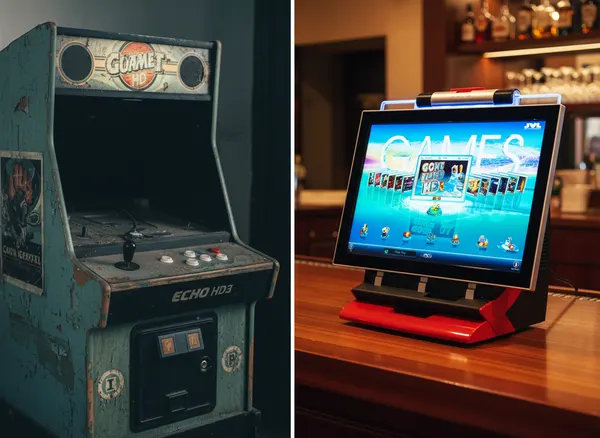
We built countertop machines for the same bars as Megatouch, through the same decades. JVL is over 40 years old as a company and our bartop line began in 1995, which is why our cabinets turn up on the used market alongside theirs.
The difference is that we are still building them. The ECHO HD3 is our current model, and it answers the format question rather than the nostalgia one.
What the ECHO HD3 is, and what it costs
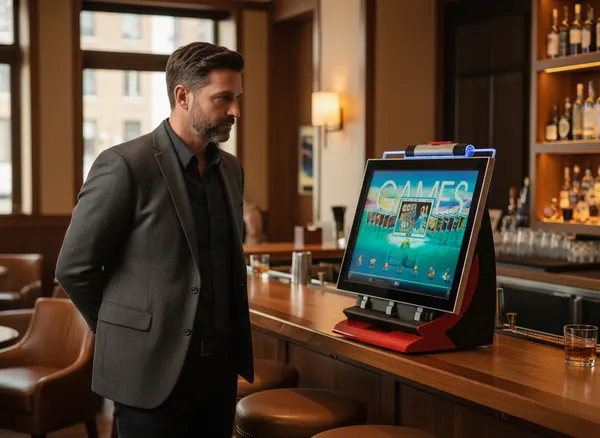
- A 22-inch Super Bright 16:9 HD LCD touchscreen. ECHO is the only 22-inch touchscreen bartop arcade on the market
- 149 pre-installed games in six categories: Action, Classic, Cards, Puzzle, Quiz and Adult
- 15 x 19.5 x 18.5 inches, 39.4 lbs
- A 360-degree swivel base, so two people can play head to head from either side
- A 25-watt, four-speaker sound system with a dedicated subwoofer
- Fully offline: no Wi-Fi, no downloads, no accounts
- Seven languages, with tournaments and leaderboards built in
- Designed in Canada, made in the USA
The Home Edition lists at $3,990 USD and the Commercial Edition at $4,250 USD. The Home Edition is free play, with no bill validator and no coin acceptor. The Commercial Edition adds a bill validator taking $1, $5, $10 and $20 notes with a 500-bill capacity, plus a quarter acceptor.
Both editions carry a 1-Year All-Inclusive Manufacturer Warranty on the same terms. Confirm the current terms with us before you buy.
ECHO is built on 30+ years of JVL bartop expertise. JVL bartops have been awarded "Best Bartop Video Game of the Year" by RePlay Magazine multiple times.
Used Megatouch against a new ECHO HD3
| Used Megatouch | New JVL ECHO HD3 | |
|---|---|---|
| Still manufactured | No, since January 2014 | Yes |
| Screen | 15" to 19" on most, 22" on the final ML-1 | 22" HD |
| Games | Whatever shipped on the drive | 149 pre-installed, six categories |
| Software | Frozen at time of manufacture | Current platform, no downloads |
| Warranty | None | One year, all-inclusive, both editions |
| Parts | Third-party and salvage | From the manufacturer |
| Free play | Usually a conversion | Home Edition is free play by design |
| Typical cost | around $300 to $2,700 | $3,990 or $4,250 list |
What the ECHO HD3 is not
It is not a Megatouch, and we are not pretending otherwise. All 149 games are our own. No machine on sale today will give you the specific games you played in 1999, so if those exact titles are the requirement, the used market is your only route.
It also costs two to four times what a used unit costs. That is the trade in one line: a new machine, a warranty and a manufacturer behind it, against a cheaper cabinet with nobody behind it at all.
Which one fits your room
For a home bar or games room
The people searching hardest for a Megatouch replacement are mostly not operators. They played these machines at a bar in 1998, or in a hotel lounge on a work trip, and they now have a basement or a finished bar with a corner going spare.
What they want back is not really a game. It is the way a screen in the bar rail made an ordinary evening sociable without anyone having to organise anything.
A free-play machine suits that exactly. There is no coin door, nothing to empty and nothing to explain to a guest. It sits there, glows, and is ready when someone sits down.
For bars, restaurants and route operators
An operator's questions are different: what goes in the location, what it takes at the door, and who fixes it in month seven. Legacy Megatouch hardware still answers the first and fails the third, because a dead sensor on a 2011 cabinet is now a scavenging exercise with an uncertain ending.
A current machine with a bill validator, a coin acceptor and a manufacturer warranty answers all three. That is the practical case for replacing route hardware rather than repairing it one more time.
How to decide between them
The choice is not really between two machines. It is between the catalogue and the format, and only one of those two can still be bought new.
Buy a used Megatouch if the original games are the point. That means you want those specific titles, you are comfortable with a service manual, and you would rather spend $1,500 on a machine that may need work than $4,000 on one that should not. Buy from a dealer who tests before shipping, and budget for a screen.
Buy new if the format is the point: a machine that works on the day it arrives, has parts available in year three, and has someone to call when it does not. Price that difference against the cheaper option honestly, because it is the only difference that still matters after the first month.
The format survived. The brand did not, and no amount of searching changes that - which is what twelve years of Megatouch listings have been telling people all along.
Frequently asked questions
What happened to Megatouch and Merit Industries?
Merit's Megatouch line ended on 7 January 2014, when the brand announced it was stopping all development and production. Merit itself had been absorbed into AMI Entertainment Network years earlier.
Did Merit Industries go bankrupt?
No public record shows one. Harbour Group bought Merit in 2002 and folded it into AMI Entertainment Network, which still trades today. Megatouch closed in 2014.
Can I still buy a used Megatouch machine, and what does it cost?
Yes, on the used market only. Classic XL, Maxx and Force cabinets ask $300 to $1,000; later ION, Aurora and RX units run $1,500 to $2,700, listed September 2026.
Can you still get Megatouch parts and service?
Not from a manufacturer. Manuals, diagrams and some legacy parts still circulate through third-party specialists and salvage sellers. Touchscreen sensors and hard drives retire most machines.
What is the best Megatouch alternative in 2026?
The JVL ECHO HD3 is the closest equivalent: a countertop touchscreen bar top game still in production, with 149 built-in games, a 22-inch HD screen and a one-year warranty.
Was JVL connected to Merit Industries or Megatouch?
No. JVL is an independent Canadian manufacturer that has built bartop touchscreen machines since 1995, alongside Megatouch rather than from it. All 149 ECHO games are JVL's own.