How to Plan a Home Arcade Room: Layout, Power, Sound, and More
Before you buy a cabinet, measure the room and the route in, understand the electrical load, and design a home arcade game room that lets people play comfortably and lets you reach the machines for repairs.

Highlights
- A full-size upright is 26 to 34 inches wide, 30 to 33 deep, 70 to 76 tall; a pinball about 27 wide, 55 deep and 76 tall
- Uprights pull 1 to 3 amps, a pinball is fused at 8; plan to 80 percent of the breaker, 12 amps on a 15-amp circuit
- Measure every doorway, hallway turn and stairwell on the route in: a cabinet that fits the room can still fail at a door
- Machines on the walls with 3 to 4 feet in front, tables in the middle; sort sound, climate and floor before games arrive
Have you seen an awesome home arcade online and want to build your own? Then this guide is for you. By taking the approach of planning one out, instead of just buying a game or two and throwing it into a room, you'll create one of the most satisfying rooms possible.
Getting it right is easier said than done, however:
- Full sized game cabinets look smaller in photos than they do standing in front of you in your basement.
- Power strips can multiply like rabbits, then suddenly a breaker trips and it's game over until you can sort it all out.
The difference between crafting a room that you use every week versus one that becomes an expensive storage unit is planning. Plan smart and you'll have an amazing game room for years to come.
What Kind Of Arcade Are You Dreaming Of?
The type of game room you can craft will be limited by how much space you have, your budget, and which types of games you want.
Made-for-home options
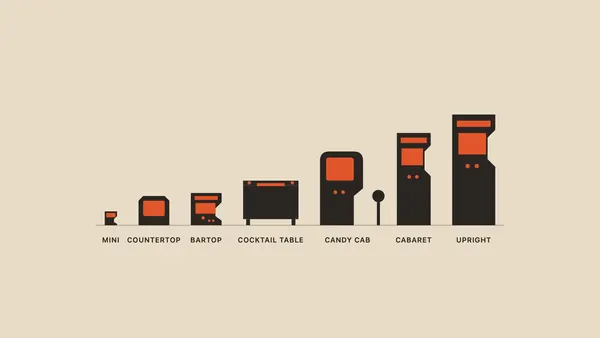
If you are content with having half-size replicas such as Arcade1Up type machines, or countertop/bartop units like the JVL ECHO HD3, then chances of filling up a room are much higher, since these are more affordable options that can easily fit through a standard doorway.
Games built for commercial locations
If you are on a quest to rebuild an arcade visited from your youth, then this presents a bigger challenge, as those games are built for commercial locations. Those tend to have thousands of square feet available, tall ceiling clearance, and easy ground floor or dock access. Having an arcade basketball machine or 22' shuffleboard table are cool things that most homes don't have, but often the reason is that it's simply not possible to get them into a room without temporarily modifying the house. In some instances, it creates a danger to the movers when a house has narrow access, or hard turns down a couple of flights of stairs.
Picking The Right Room
If you've decided on what types of games you want in the space, then the next step is figuring out where they are going to reside. You probably have a room in mind, but is it the right place? Whether it's a den, an open space in the basement, your garage, or a spare room, all of these serve as possibilities.
| Room | Good | Watch out for |
|---|---|---|
| Garage | Easy delivery, lots of floor | No climate control, temperature swings, vehicles |
| Den | Easy front access, part of the house | Guests see it, noise reaches the house |
| Basement | Out of the way, noise contained | Stairs and turns on the way in, ceiling height, humidity |
| Spare bedroom | Door closes, normal ceiling height | Doorway and hallway width, one circuit shared with other rooms |
The garage may come to mind first, since they are easy to deliver into and can be spacious. The huge downside though is that your average garage has no climate control. Depending on where you live, this can put a huge strain on your games, and wear them out faster. These are only recommended if they have a good climate system that will prevent the typical giant swings in temperature from affecting your games. You also want to make sure that there is no possibility of a vehicle accidentally hitting one of the machines.
Dens can be good, since those tend to have easy access from the front, but not everyone likes having a game room as a welcoming spot for guests to see when visiting. This is especially true if you fill it with games and they all get played, then the noise fills the house.
If a basement or spare bedroom will work, then you need to consider both the space itself as well as access. Taking the time to measure the room out - not just the length & width, but the height, in case you are considering full sized machines - is a must, combined with the measurements of the intended games.
Full-size upright video games from the '80s & '90s can be between 26 to 34 inches wide, 30 to 33 inches deep, and 70 to 76 inches tall. Some games in the early '80s were made "cabaret" style which were about half the size, but they tend to be rare. Full Pinball machines are a highly desirable option these days, but they take up a lot of space fast (typical sizes are 76" tall, 27" wide, then 55" deep). Home pinball machines, such as those now available at Costco, are slightly smaller, but not by much.
| Machine | Width | Depth | Height | Weight | Getting it in |
|---|---|---|---|---|---|
| Original 1980s-90s upright | 26 to 34 in | 30 to 33 in | 70 to 76 in | about 250 lb | Measure every door and turn on the route |
| Pinball machine | 27 in | 55 in | 76 in with the backbox up | about 250 to 270 lb | Ships with the backbox folded; measure the stairs and landings |
| Full-size home replica (Arcade1Up class) | about 19 in | about 22 in | about 5 ft | about 68 lb | Flat-packed, assembled in the room |
| Bartop / countertop (JVL ECHO HD3) | 15 in | 19.5 in | 18.5 in | 39.4 lb | Comes in a box, fits any doorway |
You also want to make sure that there is some wiggle room for accessing the back of the game in the event of service. Packing games in like they were sardines in a can will result in headaches any time you need to work on or adjust the machines.
You also need to consider the placement of any windows, radiators, columns, HVAC returns, and door swings. Those fixed objects decide the layout more than décor ever will. It is a good idea to put all of this onto paper, or use a planning app on your phone as you craft your vision.
So we have a tentative room and games. What about the access?
Measure all of the following, from the driveway or garage to the final wall:
- Door widths
- Hallway turns: in tight hallways, you'll want a good 10-12 inches in extra space, otherwise you run the risk of the cabinet damaging the corners or walls
- Stairwells
- Any tight corners
A cabinet that fits the floor can still fail at a doorway.
Depending on what game(s) it is that you are getting, it may not be possible for the game to fit in the access ways or it may require modifications to your home where it becomes prohibitively expensive to bring the game to its final destination. As an example, I once sold a shuffleboard table into a home, but they wanted it on the top floor and it was a 22' long table. They had the space, but those tables don't come segmented, so they had to remove a window and rent a crane to get it into place. This was over ten years ago and it was almost $2500 to accomplish that task then; now with much higher rates, that could easily cost double.
This is where many made-for-home options are beneficial - no quarter or half-size arcade machine where they come in a box and need to be assembled, or a bartop game like the JVL ECHO HD3 run into these kinds of issues.
Power: Treat Cabinets Like They Were Appliances
Next up, you need to plan on the electrical pull. Most '80s & '90s video cabinets draw roughly 90 to 240 watts in real use, often around 1 to 3 amps on a 120-volt circuit. If you've imported a game from a region like Europe, you need to be sure that it isn't set up with a 220V power supply, as that will not work in North American homes without a specialized transformer. Power needs for each game should be printed on a label on the back of the machine, or found within their original owner manuals.
Modern LCD and PC-based home cabinets can be a lower power draw, while pinball machines are hungrier. They are fused at 8 amps, so plan for that even though a running machine may pull less (if they are older than the mid-'70s, then they can draw more). It is best to discuss the needs with a licensed electrician to ensure that you are not creating a power hazard with the room that will end up tripping the breakers. Many houses have a single circuit serve multiple outlets across rooms, so if you need to have the room modified especially for this purpose, then that is an expense to consider.
Use the 80 percent rule. A 15-amp circuit should not be planned as a continuous 15-amp load; stay near 12 amps with all of the games on circuit. A 20-amp circuit should stay near 16. A conservative planning number for original, full video games is 5 to 6 per 15A circuit. On pinball, that easily goes higher. Plug your games in using surge protectors, and you can turn them all on using the switch there.
If you are building or renovating:
- Run dedicated 20-amp circuits with 12-gauge wire to the machine walls.
- Place outlets within about 6 feet of each planned cabinet so you are not stretching cords across walkways.
- Commercial-grade receptacles and quality surge protectors are worth more than a chain of cheap power strips.
- Floor boxes work for fixed layouts; overhead drops work if you expect to rearrange.
- Never run cords across play paths and don't use extension cords.
Have an electrician confirm load if the room is in an older house, a garage, or a basement with limited panel capacity. GFCI protection is common in those spaces. Map every load: cabinets, pinball, lighting, HVAC, network gear, and any fridge or ice maker. Power planning is cheaper before drywall than after the first tripped breaker during a party.
Creating A Comfortable & Clean Layout
There are two goals for any layout to accomplish: ease of playing for you and any guests, and the ability to access the machine internals for when you need to have them worked on. Even if you hire someone else to repair the games, they need to be able to access a game without rearranging the entire room.
There are many ways to arrange games, but this depends on the size of each piece, the quantity, and the size & shape of the space. Most rooms are just going to be rectangles, but there may be variations with angles that can make for creative designs. You may start small with only a game or two, with plans to expand down the road - just keep the ultimate goals in mind so that you don't end up with a maze that people dread to enter instead of anticipating with excitement.
The typical setup is to put your machines on the perimeter and keep the center open. If you can, place a "hero" piece where you see it first upon entering that sits at the center opposite of the doorway. This can be a restored cabinet, a pinball machine, or a racer, becoming the piece that draws attention and awe the moment people enter the space. That isn't essential however, and doesn't work in small rooms.
In any instance, you want to leave room around each machine:
- Uprights: about 3 to 4 feet in front, so a player can stand naturally and a second person can watch.
- Multiplayer racers and shooters: more on the sides for access.
- Pinball: standing room at the front plus access beside the cabinet for repairs.
- Several cabinets in a row: leave a few inches between them so plugs and side panels stay reachable.

The ideal game room allows people to be able to walk through any aisle space without disturbing any other players. Keep exits and vents clear, which is good practice even if your local jurisdiction doesn't require it for fire code. Put short-session games near the entrance and longer sessions deeper in the room. If you also want a cocktail cabinet, air hockey, or a small bar, treat those as separate zones with their own clearance. A pool or air-hockey table belongs in the middle (with even more space needed around them than video games or pinball machines); cabinets belong on walls. Mixing those rules is how rooms start to feel cramped.

You also need to consider being able to clean behind the machines at least once or twice a year, removing dust bunnies that can accumulate and create a fire hazard if allowed to get out of control.
Consider padded barstools or chairs with a back to them to give the space some comfort. A small sofa can be great for guests who aren't currently playing (or are playing a console you've set up). If you expect to add machines later, leave a blank wall section and hold on to any layout plans so you can easily fill them in later.
Crafting Your Game Room's Sound Profile
The cacophony of a bustling arcade is part of the charm until it is not. With one or two games it will hardly be noticeable, but stack several games into a space, even on lower volume, and all of that will become amplified. There are solutions at every budget:
- Cheap: area rugs or shop pads, upholstered seating, and fabric curtains.
- A step up: acoustic panels and a few corner bass traps to tame the booms without neutering the games.
- For vibration: isolation pads under subwoofers can stop or reduce those vibrations from traveling, particularly if the game room is on a floor above a living space.
If the room shares a wall with any bedrooms, then it would be wise to soundproof this to your budget before any games arrive. Solid-core doors with weatherstripping and a sweep help more than you might expect, while extra insulation or a second layer of drywall with damping compound helps more than decorative foam alone. Place loud machines away from shared walls when you can. Tune volumes for a normal evening, not an empty room. If people have to raise their voices to talk, or you can't hear yourself think, then the mix is too high.
Create simple sound zones if the room is large: game wall at one level, conversation or bar area at another. Machines with external volume knobs and headphone jacks can also be a great solution, although for original games, these features are rare and may require modding.
Lighting, Climate, Flooring, and the Rest
Your game room's lighting should flatter marquees and game screens instead of washing them out. Glare on a screen can ruin a play session, as can glare from other machines if you aren't careful.
- Dimmable ambient light works best, and there are many LED solutions out there for creating a warm light environment that strikes a balance where players won't even think about it.
- Control glare from windows with shades; sunlight can overpower both CRTs and LCDs.
- Consider a darker, low-sheen wall paint to keep reflections down.
Cabinets and power supplies generate heat. This is another reason to not cram every game possible into a space.
- In a closed basement or garage, plan cooling and dehumidification sources the way you plan outlets.
- Stable temperature and moderate humidity protect wood, art, and electronics better than any cosmetic upgrade.
- A garage arcade without climate control will leave this whole endeavor as an expensive, albeit short-term hobby.
What floor to use? That depends on the trade-offs you want.
- Hard surfaces such as tile, vinyl composite, concrete (plain or acid washed), or wood floors do make it easier to roll heavy machines across them and to clean up spills. They tend to scuff & scratch easily though, and have little to no sound dampening in them.
- Carpet and rugs will absorb sound, but will generate static electricity (which can damage electronic games, depending on the exposure) and are harder to clean.
- Many rooms mix a durable hard floor with thick rugs in the play zones.
You also have to consider the grade of the room; level, solid flooring matters, especially for pinball machines. Games themselves usually have leg levelers that can be adjusted for this purpose.
Cable management, networking, and storage will finish the room. Hide cords along baseboards or in raceways, using cable guards to help manage them. If possible, a wired network drop is going to be faster and more reliable than Wi-Fi for any online connected devices in the room (not an issue with those '80s/90s originals). Give yourself a closet or cabinet for extra game boards, cleaning supplies, and spare parts.
Safety is unglamorous but it's non-negotiable:
- No overloaded strips
- No blocked exits
- Anti-tip anchors on tall or top-heavy cabinets, which may also be necessary if you live in an area prone to frequent earthquakes, such as the West coast
A Game Room That You Will Want To Spend Time In
The best home arcades are planned like small venues and finished like living rooms. This guide lays the groundwork, but ultimately your imagination & creativity will give it the personality needed to stand out and maybe even go viral on the internet. Don't be afraid to take your time with it either. As the old story goes, slow & steady wins the race.
Frequently asked questions
How much space do you need for a home arcade room?
Enough for each machine's footprint plus about 3 to 4 feet of standing room in front of an upright, side access beside a pinball machine and a few inches between cabinets. Keep machines on the walls and the centre open.
How much power does an arcade machine use?
Most 1980s and 90s uprights draw roughly 90 to 240 watts, about 1 to 3 amps at 120 volts, and a pinball machine is fused at 8 amps. Plan at 80 percent of the breaker rating, so about 12 amps on a 15-amp circuit.
Is a garage a good place for a home arcade?
Only with climate control. Easy delivery and floor space are the upside, but temperature swings and humidity wear out wood cabinets, artwork and electronics, and a parked vehicle is a risk to the machines.
Will a full-size arcade cabinet fit through a standard door?
Usually, but measure first. Original uprights are 26 to 34 inches wide and 70 to 76 inches tall, so check every door, hallway turn and stairwell on the route, with 10 to 12 inches to spare in tight hallways.
How do you keep a home arcade room from being too loud?
Start with rugs, upholstered seating and curtains, then acoustic panels and bass traps. For a wall shared with a bedroom, a solid-core door with weatherstripping and a second drywall layer with damping compound help most.
Do bartop arcade machines need special wiring or delivery?
No. A bartop such as the JVL ECHO HD3 weighs 39.4 pounds, measures 15 by 19.5 by 18.5 inches, plugs into a standard outlet and ships in a box, so it clears the doorways and circuits that full-size cabinets struggle with.
Sources
7 sourcesThe materials we relied on while writing this article.