Arcade Machine Revenue Share vs Buying: Which Is Better for Your Bar or Venue?
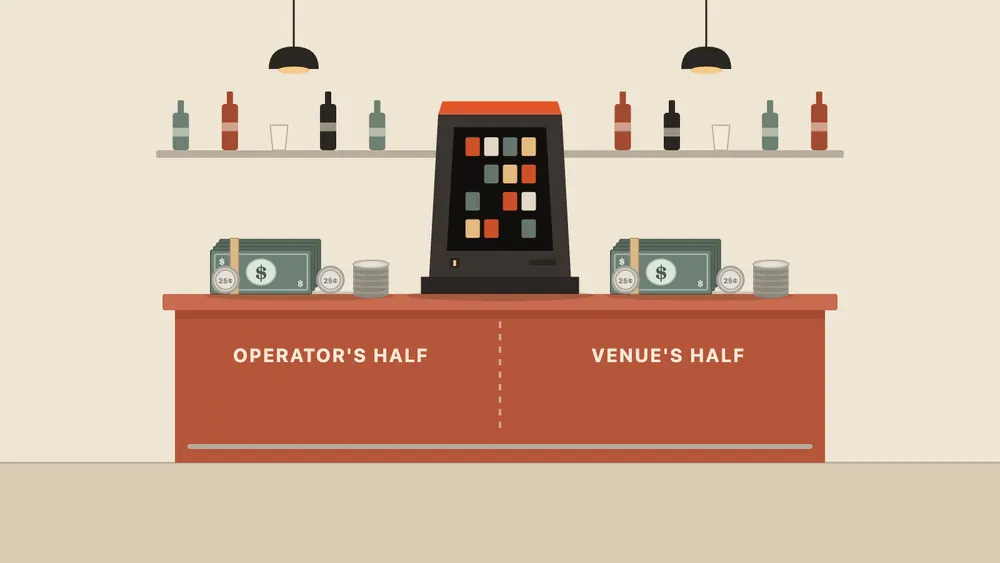
A route operator's machine costs you nothing and pays you half the takings. Buying keeps all of them, at the price of the investment and the upkeep. Here is where one overtakes the other.
Highlights
- Under a 50/50 revenue share, a machine taking $150 a week gives the venue $75 with no outlay; the operator owns it, fixes it and collects
- Buying a machine for about $4,000 keeps the whole $150 and pays for itself in about half a year, about seven months after running costs
- Paying for itself isn't winning yet: at $150 a week the owner overtakes the split after about a year, or a bit over a year once running costs are counted
- Unproven traffic or no appetite for upkeep points to revenue share; steady traffic and spare capital point to buying
Revenue share and buying split the same takings in different ways. One gives you half with no money down and no repairs; the other gives you all of it in exchange for the price of the machine and the upkeep. Which pays more comes down to how busy the machine will be.
Below: how each deal works, the numbers side by side, a decision rule, the questions to ask an operator, and a middle option.
How an Arcade Revenue Share Deal Works
In a revenue share deal, also called a placement or route deal, the machine belongs to an operator: a local amusement company that keeps machines in bars, restaurants and similar places along a route. You provide the space; the operator provides almost everything else.
The usual division of work:
- The operator buys the machine, delivers it and sets it up.
- The operator fixes it when it breaks, because it's the operator's machine.
- The operator collects the cash, often weekly, and pays the venue its share weekly or monthly.
- The venue provides floor space, power and someone who notices when the machine is down.
- The takings are split at the agreed rate.
Operators who publish their terms describe the same deal: they install and maintain the machines at no cost to the venue, keep ownership, and split the money evenly. One promises repairs the same day; another hands over a receipt for each machine at every collection.
Half the takings isn't all a venue gives up. The operator chooses the machine, decides when it gets serviced or swapped, and counts the cash. That suits a venue that wants none of that work, and it's why the collection receipt matters: it's the venue's only record of what the machine took.
A good operator earns its half. It turns up when the machine breaks, swaps games that have gone stale, and keeps the machine working on a busy Friday night. A poor one leaves a dead machine in the corner for weeks, and half of nothing is still nothing. Before you sign, ask other venues on the route how quickly the operator responds.
The split: 50/50, and who gets more when it isn't
An even split is the usual starting point, and it's the figure we use across this blog. When the split isn't even, the side carrying more of the cost usually takes more:
- Operators ask for 60/40 or 65/35 in their own favour on expensive machines, or when they've just put in new equipment.
- Some industry guides go as far as 80/20 to the operator, on the logic that the operator paid for the machine.
- For small amusements in pizzerias, one vending operator called 15 to 20 percent to the venue the norm, which leaves most of the money with the operator.
- The venue can get the bigger share too. An industry columnist described an entertainment centre that kept 65 percent and left the operators 35, and a venue that puts in marketing or prime floor space can ask for more.
Whatever the number, write down whose share is whose. "60/40" on its own can be read either way, and some articles about arcade deals get the direction backwards.
Check what the split is taken from, too. Some operators split what's left after fees, and those fees aren't small: one lists a 20 percent copyright fee on its digital jukeboxes and 30 percent on some online arcade games. Half of what's left after fees is less than half of what your guests put in.
“This means there's no upfront rental fee; we split the revenue 50/50 after any applicable fees.”
Contract terms to expect
Few arcade operators publish their contracts. The closest well-documented model is the vending machine placement agreement, which works the same way: the operator owns the machine, and the location hosts it for a share. Those agreements usually run one to three years, renew automatically, need two or three months' notice to end, and often give the operator exclusive rights in the building.
Some arcade deals have no contract at all. An industry columnist described one such arrangement as a mess; it ended with the venue removing the operators and buying its own machines. Get the terms on paper.
| Term | What is common | What to check |
|---|---|---|
| Split | 50/50 | Which side gets the larger share, and whether fees come off first |
| Length | One to three years, renewing automatically (vending agreements) | The renewal date and the notice needed to stop it |
| Repairs | Paid by the operator, who owns the machine | How fast they come out when it breaks |
| Collections | Often weekly; paid out weekly or monthly | A receipt for each machine at each collection |
| Exclusivity | Common in vending agreements | Whether you can add your own machine or another operator's |
| Exit | Two or three months' notice (vending agreements) | Early-exit fees and who removes the machine |
| Machine rotation | Some operators swap weak earners every few months | Whether rotation is promised in writing |
How Buying Works
When you buy, you become the operator. You keep every dollar the machine takes, and you take on the work the route operator would have done:
- emptying and counting the cash box;
- arranging repairs, and paying for them once the warranty ends;
- choosing the price per play and where the machine stands;
- carrying the loss if the machine earns less than you hoped.
In return you get control. You can move the machine, change the price, take it to an event or sell it, and nobody else decides when it gets serviced or replaced.
Owning also means the cash is yours to manage. Someone has to empty the box on a schedule, count it, bank it and keep a simple log, both for your books and to see whether the machine is earning its spot. Most venues fold that into closing duties.
Running costs are modest but real. Our bar model sets aside about $55 a month for electricity, repairs and a permit. Insurance, staff time and cash handling come on top, so price those for your own venue. The bar ROI article goes through each line.
New or used
A used countertop machine costs less up front and more in uncertainty. Megatouch machines, the touchscreen bar games that went out of production in 2014, sell on eBay for anywhere from a few hundred to a few thousand dollars, usually without a warranty. Our Megatouch alternative guide covers what to check before buying one.
 A new commercial machine is the other route. JVL makes one: the ECHO HD3 Commercial Edition, at about $4,000, with a 22-inch touchscreen and 149 built-in JVL games. The Commercial Edition takes $1, $5, $10 and $20 notes and quarters; the Home Edition is free play and has no bill or coin acceptor. The current price is on the ECHO page. In the numbers below, $4,000 stands for any new commercial machine at about that price.
The Numbers: Revenue Share vs Buying at $150 a Week
The comparison uses the base case from our bar model: one machine taking $150 a week at $1 a play, the top of the range published for bars and other route stops. That's roughly one paid play every half hour across a twelve-hour day. If that sounds busy for your room, look at the lower rows in the next table.
| Revenue share (50/50) | Buy (about $4,000) | |
|---|---|---|
| Up-front cost to the venue | Nothing | About $4,000 |
| Venue keeps each week | $75 | $150 |
| Repairs and collections | The operator's job | Yours, about $55 a month in our model |
| Paying back the machine | Nothing to pay back | About half a year; about seven months after running costs |
| After that | $75 a week | $150 a week, twice the split |
This assumes the same machine takes the same money under either deal. In practice it may not: an operator who rotates weak earners can lift the takings, and an owner who never changes the games can let them slide.
The crossover point
Paying for itself isn't the same as winning. By the time an owned machine has earned back its $4,000, about half a year in, a venue on revenue share has already pocketed around $2,000 without spending anything.
The owner only pulls ahead once the extra $75 a week has covered the whole purchase price, which takes about a year. That's the crossover. Before it, the revenue share venue is ahead; after it, the owner is, and the gap grows every week.
Running costs push the crossover to a bit over a year, and that's with the split venue paying nothing at all, which flatters the split a little.
A handy rule of thumb: before running costs, buying overtakes the split at about twice the payback time, because the split hands you half of the same takings for free.
When the machine takes less, or more
Traffic decides the answer. Here is the same comparison at the other weekly figures in our bar model, before running costs, which push every crossover a little later.
| Machine takes per week | Venue's half on a 50/50 split | Owner's payback of about $4,000 | Owner overtakes the split after |
|---|---|---|---|
| $50 (route-stop floor) | $25 | ~80 weeks | About three years |
| $75 (pessimistic) | $37.50 | ~53 weeks | About two years |
| $150 (base case) | $75 | ~27 weeks | About one year |
| $225 (optimistic) | $112.50 | ~18 weeks | About eight months |
If you expect to keep the machine for less time than its crossover, revenue share pays more. If you expect to keep it for years at a steady figure, buying does. For what a whole arcade takes, as opposed to one machine in a bar, see how much an arcade makes.
A Decision Rule
Neither model is better in general. Match the deal to your traffic, your cash and your appetite for upkeep.
Revenue share fits when:
- traffic is low, new or unproven, and you can't picture a paid play every half hour;
- nobody on staff wants to empty cash boxes or chase repairs;
- $4,000 has a better use in your business right now;
- you want to see whether your guests play at all before committing.
Buying fits when:
- traffic is steady enough that the machine should take close to $150 a week, week after week;
- you have the capital and can wait a year or so to come out ahead;
- someone can handle the cash and basic upkeep;
- you want to choose the machine, the games and the price yourself.
You don't have to choose once and for all. A venue can start on revenue share, watch the collection receipts for a few months, and buy once they show steady takings, as long as the contract lets it leave. That's why the exit terms matter as much as the split.
Questions to Ask an Operator Before You Sign
Get the answers in writing, and make sure they end up in the contract, not just the sales pitch:
- What is the split, and which side gets the larger share?
- Is the split taken from gross takings, or after fees? Which fees, and how much?
- How often do you collect, and do I get a receipt for each machine?
- Who pays for repairs and parts, and how soon do you come out when a machine is down?
- How long is the term, does it renew automatically, and how much notice ends it?
- Is there an early-exit fee, and who removes the machine at the end?
- Does the deal give you exclusivity? Can I add my own machine or another operator's?
- Will you swap a machine that earns little, and how often?
- Who pays for power, internet or any subscription the machine needs?
- Can I buy the machine later, and how would its price be set?
Fees catch out more venues than the split does. One operator, for example, charges bars a monthly subscription for a trivia service it installs, on top of the split.
A Middle Option: Leasing or Financing a Machine
Between the split and an outright purchase there are ways to pay for a machine over time and still keep its takings:
- A flat monthly fee. One company leased games to pizzerias for $75 a month instead of sharing revenue, and the venues kept everything the games took.
- An equipment lease. You use the machine for a set period, then buy it at fair market value, return it or renew. Many leases include maintenance.
- Lease-to-own. Some distributors offer commercial leases with the option to buy the machine for $1 at the end.
- A loan, usually repaid over two to six years, with the machine often serving as collateral.
A flat fee only beats the split when the machine earns enough. At $150 a week, a $75 monthly fee leaves the venue far more than a 50/50 split would. In a quiet month, though, the fee is still due, while a split simply pays less.
Leasing suits a venue that trusts its traffic but would rather not tie up $4,000 at once. If the traffic is the open question, a revenue share tests it more cheaply.
With any lease or loan, add up every payment over the term and compare the total with the cash price. Lenders quote anything from about 6 to 24 percent a year, so a long term at a high rate can cost far more than buying outright.
Frequently asked questions
What is a typical arcade machine revenue share split?
Usually 50/50 between the operator who owns the machine and the venue, often after fees. On expensive machines operators ask for 60/40 or 65/35 in their own favour, so check whose share is the larger one.
Who pays for repairs in an arcade revenue share agreement?
Normally the operator, because it owns the machine; the venue provides the floor space and power. Ask how quickly the operator comes out when the machine breaks, since a broken machine earns nothing for either side.
When does buying an arcade machine pay more than revenue share?
Once it overtakes the split. A machine bought for about $4,000 and taking $150 a week catches up with a 50/50 deal in about a year, or a bit over a year once running costs are counted.
Can I lease an arcade machine instead of buying it?
Yes. Lenders and distributors offer commercial leases, some with a $1 buyout at the end. You pay a fixed amount each month and keep the takings, so add up every payment and compare it with the cash price.
Can any bar or venue buy and run its own arcade machine?
In many places, yes. Some states and cities license coin-operated machines or require them to be placed by a licensed operator, so check local rules before you buy.
Sources
10 sourcesThe materials we relied on while writing this article.
- Arcade Heroes, profit-sharing, December 2014
- Arcade Integrations, route operator guide, 2026
- Player Two, revenue sharing, 2024
Show 7 moreShow less
- CityWide Amusements, business arrangement, 2026
- Sexton's Music & Games, getting amusements installed, accessed November 2026
- RePlay Magazine, Jersey Jack column, September 2019
- PMQ Pizza, retro arcade games, September 2016
- VMFS USA, vending contract essentials, 2026
- Crestmont Capital, arcade machine financing, May 2026
- The Pinball Company, equipment financing and leasing, 2026