How Much Does an Arcade Make? Revenue per Day, Month and Year
An arcade's revenue is its machines times what each takes in a week. Here is that arithmetic for a bar, a barcade, a 30-machine arcade and a Dave & Buster's store.
Highlights
- An arcade's game revenue is machines times weekly takings: about $50–150 per machine in a bar, $200–500+ where people come to play
- A 30-machine arcade takes roughly $850–2,150 a day from games, or $300,000–800,000 a year, before any costs
- A Dave & Buster's store takes about $170,000 a week, about 60% from games and 40% from food and drink
- At barcades games are often only 10–25% of revenue: the bar carries the business and the machines bring people in
What an arcade makes depends less on how many machines it has than on why people walk in. The same 30 machines take about three times as much in an arcade people visit to play as they do in a bar, where the games sit beside the drinks.
Below: the arithmetic behind those figures, how food and drink change the picture, what real venues of each size make, and why some figures you will find online are ten times higher.
The Arithmetic: Machines Times Weekly Takings
Every estimate of what an arcade makes, from a single cabinet to a national chain, comes down to one line:
number of machines × what one machine takes in a week = the venue's weekly game revenue
The second number is the one that moves, and operators split it by where the machine stands rather than by what it is:
- route stop, where the machine sits in a bar, restaurant or laundromat beside the main reason people came: about $50–150 a week, and $50–100 in weaker spots;
- destination venue, where playing is a main reason for the visit: about $200–500+ a week.
The same cabinet with the same games at the same price can land in either range. What changes is how many people pass it with time and money to spare. Our bar payback model explains where both ranges come from.
A day is a seventh of a week, a month a little over four weeks, a year 52. Here is what that gives for four common setups:
| Setup | Machines | Per machine, per week | Per week | Per day | Per month | Per year |
|---|---|---|---|---|---|---|
| One machine in a bar | 1 | $50–150 | $50–150 | $7–21 | ~$215–650 | $2,600–7,800 |
| Game corner in a bar or restaurant | 5 | $50–150 | $250–750 | $36–107 | ~$1,080–3,250 | $13,000–39,000 |
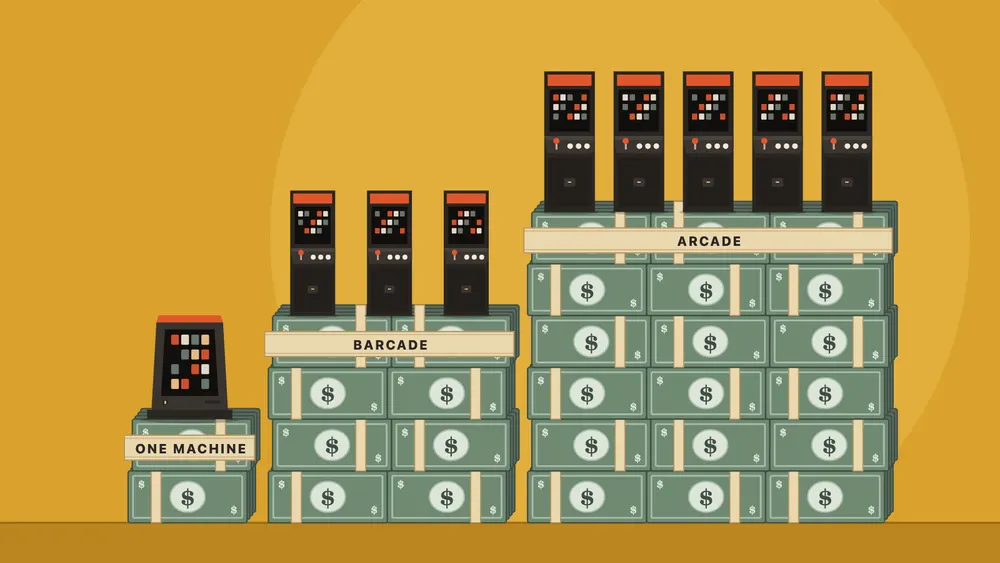
| Barcade, 30 machines beside the bar | 30 | $50–150 | $1,500–4,500 | $214–643 | ~$6,500–19,500 | $78,000–234,000 |
| Arcade, 30 machines, people come to play | 30 | $200–500+ | $6,000–15,000 | ~$860–2,140 | ~$26,000–65,000 | $312,000–780,000 |
The last two rows have the same number of machines and a fourfold difference in revenue. That gap is the whole story of arcade income: the floor plan matters less than the reason people are standing on it.
A quick way to test any weekly figure is to turn it back into plays. At $1 a play, $150 a week is 150 plays, about 21 a day, or one paid game every half hour or so across a twelve-hour day. A destination machine at the top of its range needs about 70 plays a day. If you cannot picture that many plays where your machines would stand, use a lower figure.
Games Are Only Part of the Venue: Food and Drink
The table counts game revenue only. Most venues people call "an arcade" today also sell food and drink, and how the money splits between the two depends on the kind of venue.
Eat-and-play chains
Dave & Buster's, the largest chain in the US, publishes its split every year. In its latest full year its stores took about $2.1 billion, roughly 60% from games and other entertainment and 40% from food and drink. Entertainment there means mostly ticket-and-prize games and simulators, plus bowling, billiards and parties at some stores.
The mix is shifting. Food and drink has been growing while game revenue slips, and by the middle of 2026 it was close to 40% of sales. The company puts the drop in games down to fewer walk-in visitors, and the growth in food to a new menu and a deal that bundles a meal with a game card.
There is a good reason chains still lean on games. A dollar of game revenue costs Dave & Buster's about 8 cents in direct costs, against about 25 cents for a dollar of food and drink. Games bring in less of the growth, but they keep more of each dollar.
Barcades

At a barcade the split runs the other way. Barcade's co-founder told CNBC in 2017 that games brought in as little as 10% of revenue at some of its bars and 20–25% at others. Most of the money comes from the bar; the machines are the reason to choose that bar.
That gives a simple rule. If games are 10–25% of a barcade's revenue, the whole venue takes roughly 4 to 10 times what its machines take. A barcade whose 30 machines take a few thousand dollars a week is, in total, a much bigger business than its game line suggests.
“We're only charging 25 to 50 cents per game, but for a beer and sandwich, it's $15.”
Game-led arcades
In a classic arcade or a small family entertainment centre, games stay the main line. Business-planning guides put them at about 50–70% of revenue, with food and drink at 15–25% and parties making up most of the rest. These are estimates rather than audited accounts, but they fit the pattern: the more the games are the reason to come, the larger their share.
What Real Arcades of Each Size Make
The arithmetic gives a range for any setup. Published figures show where real venues fall inside it.
The US industry as a whole
IBISWorld counts about 7,100 arcade, food and entertainment complexes in the US, an industry of about $6 billion a year. Divided evenly, that is about $840,000 per business, but the average says little. A few large chains take a big slice of the total and pull it up, while thousands of small game rooms and barcades make a fraction of it. Revenue dipped slightly in 2026, and IBISWorld expects it to keep declining for the next few years. Our article on why arcades failed covers how the industry got here.
A large eat-and-play store
A Dave & Buster's store takes in about $170,000 a week. That is roughly $24,000 a day and close to $9 million a year, and around $100,000 of the weekly figure comes from games. These are big venues, from 16,000 to 70,000 square feet, with a large game floor, a full kitchen and a bar. They mark the top of the scale, not a target for a new operator.
A small arcade or barcade
Independent arcades do not publish accounts, so the best available figures are planning estimates. Report Desk puts a small retro room of about 15 machines at roughly $150,000–350,000 a year, and a mid-size arcade of about 30 machines at $360,000–600,000. Both sit inside what the per-machine arithmetic gives for destination venues, where 30 machines come to about $300,000–800,000 a year. The guide calls its figures illustrative, and they are best read that way.
A barcade with the same 30 machines makes less from games, because they earn at route-stop rates, and more in total, because the bar carries the business.
Within any of these bands, the spread comes from the same few things: how busy the street outside is, how many hours the doors are open, and whether the venue fills its quiet weekday afternoons with birthday parties, leagues or school groups.
A single machine in a bar
One machine at a route stop takes about $50–150 a week, or $2,600–7,800 a year. Whether that pays back depends on what the machine cost and who owns it:
- if the venue buys the machine, it keeps everything the machine takes. A commercial touchscreen bartop such as the JVL ECHO HD3 Commercial Edition costs about $4,000, and at $150 a week a machine at that price covers it in about 27 weeks before running costs. The bar payback model shows the slower and faster cases;
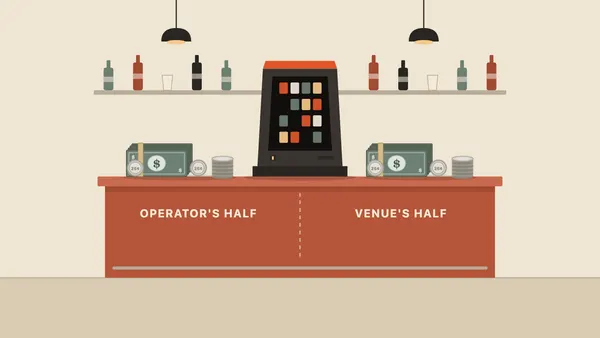
- if a route operator places the machine, the usual arrangement is a 50/50 split, so the venue keeps about half and pays nothing up front. Revenue share or buying compares the two.
Why Some Estimates Are Ten Times Higher
Search for what an arcade machine makes and you will find claims of a few hundred dollars a day for one machine. That is ten to twenty times the route-stop range above, and it usually comes from one of these mix-ups:
- destination-venue figures applied to a bar or shop, where most guests did not come to play;
- whole-venue revenue, including food, drink and parties, quoted as if one machine earned it;
- a supplier's weekly figure for its own machine, such as $300 a week, treated as a benchmark rather than a sales claim;
- event rental rates of $350–500 per machine per day, which are what a host pays for a party, not what players put in;
- old per-game estimates, some from 2014, that are still copied from site to site.
The plays test settles most of them. A few hundred dollars a day at $1 a play means a few hundred plays: one every two or three minutes, twelve hours a day, every day. A handful of machines in the busiest arcades manage that on a Saturday. Almost none manage it all year.
What Moves an Arcade's Revenue
Every venue figure on this page comes from four inputs. Change one and the total changes with it.
Traffic
Revenue is people passing the machines, times the share who stop, times the games each of them plays. A bar with 200 guests on a Friday, one in ten of whom plays three games at $1, takes $60 from games that night. Double the guests and you roughly double the plays. Double the machines without more guests and the same plays are spread across more cabinets. Placement inside the room works the same way: a machine on the path to the bar or the restrooms is passed by far more people than one tucked into a far corner.
Price per play
Operators charge 50 cents to $1 a play, and $1 is the usual base today. Chains like Dave & Buster's sell game cards loaded with credits instead of taking coins, which lets them raise the real price through bonuses and food bundles. A higher price only helps if players keep coming: in a bar, a game that costs more than a drink loses the impulse play that route-stop revenue depends on.
Game mix
Different games earn differently. The big chains build their floors around prize games, where players win tickets, and simulators: sessions are short and people come back for another go. In a bar, quick games a guest can start with a drink in one hand fit the play window best. Which games earn the most is a question of its own, answered in the most profitable arcade games.
Hours and days
A machine only earns while the doors are open and people are in the room. Most venues take a large part of their week on Friday and Saturday evenings, and school holidays lift family venues. An arcade open twelve hours a day, seven days a week, has more chances than a bar whose busy hours start at 8 pm. When you turn a weekly figure into a daily one, remember that the average day hides a slow Tuesday and a crowded Saturday.
Revenue Is the First Number, Not the Last
Everything above is gross revenue: what goes into the machines and across the bar. Turning it into a decision takes other numbers, each covered in its own article:
- what it costs to run an arcade each month, from rent to repairs: are arcades expensive to run;
- whether starting or buying an arcade business is worth it: is owning an arcade worth it;
- how fast one machine pays for itself in a bar or event venue: arcade machine for a bar: ROI;
- whether to buy machines or share revenue with an operator: revenue share vs buying;
- which games earn the most: the most profitable arcade games.
If you are estimating revenue for a venue of your own, start with the table. Pick the row closest to your setup, decide honestly whether people will come for the games or for something else, and test the weekly figure by turning it back into plays. If the plays look impossible in your room, the revenue is too.
Frequently asked questions
How much does an arcade make a day?
One machine in a bar takes about $7–21 a day. A 30-machine arcade where people come to play takes roughly $850–2,150 a day from games. Food, drink and party bookings come on top.
How much do arcades make a year?
A small arcade with about 30 machines takes roughly $300,000–800,000 a year from games, depending on traffic. A Dave & Buster's store takes close to $9 million. The whole US industry is about $6 billion.
How much does one arcade machine make?
About $50–150 a week in a bar or restaurant, and about $200–500+ a week in an arcade where people come to play. The difference comes from traffic and why guests came, not from the machine.
Do arcades make more from games or from food and drink?
It depends on the venue. Dave & Buster's takes about 60% of its revenue from games and 40% from food and drink. At barcades, games are often only 10–25% of revenue, and the bar carries the business.
Why do some sites say one machine makes hundreds of dollars a day?
They usually apply busy-arcade figures to every location, count a whole venue's sales, or repeat supplier claims. At $1 a play, a few hundred dollars a day means a paid game every two or three minutes.
Sources
7 sourcesThe materials we relied on while writing this article.