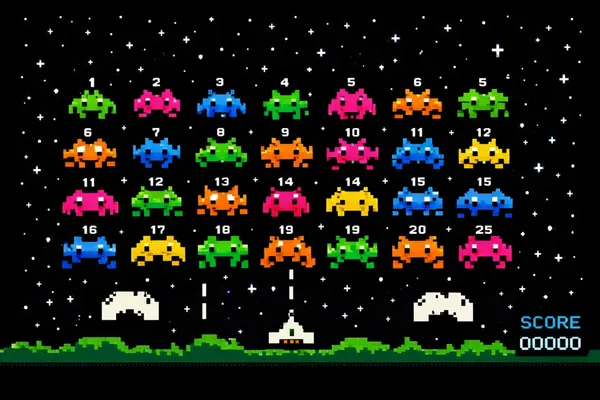
Arcade Scoreboards in 1980s: The Real Story Behind Arcade High Scores
The short ranked list on a 1980s arcade screen turned regulars into rivals. How it worked, why it asked for three initials, and where the mechanic lives now.
Most people who spent time in an arcade remember two things about it: the noise, and the list. The list sat on the screen between games - a handful of scores, ranked, each one tagged with three letters that stood in for a person. If your letters were on it, everyone who walked up to that machine saw them.
Search for that list today and you find forum threads, score brags with no source, and videos of cabinets in someone's garage. This article is the plain account: what the high-score table was, how a 1980s machine remembered a number after the power went off, why it shaped game design, and where the mechanic went. It did not disappear. It moved indoors, into dens, basements and home bars, where a leaderboard now has a family on it instead of a neighbourhood.
What Is an Arcade Scoreboard?
An arcade scoreboard - more precisely a high-score table - is the short ranked list of the best scores a single arcade machine has recorded. Each score is labelled by the initials of the player who set it. It belonged to that one cabinet in that one room. Nothing was shared, uploaded or compared anywhere else.
That local quality is the whole point, and it is what modern readers most often misunderstand. A high-score table was not a record of the best players in the world. It was a record of the best players who had walked past that machine.
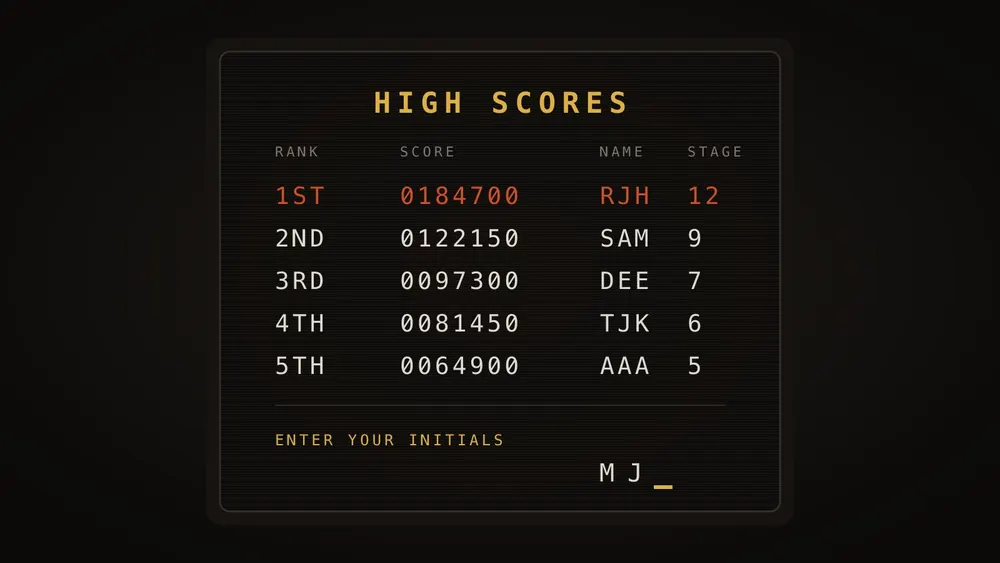
An example of an arcade leaderboard structure.
The layout varied by manufacturer, but the same handful of fields did most of the work:
- The rank, usually the top five to ten scores
- The score itself, padded out with leading zeros on many games
- Three initials entered by the player
- On some titles, the level or stage the run ended on
The table appeared during attract mode - the loop of demo footage, title screens and score lists a cabinet played to itself while waiting for a coin. Anyone standing in front of the machine read it before they played, which is why it worked as public notice rather than private record.
The Golden Age: When Arcade High Scores Took Over
The high-score table arrived early in the arcade boom and became standard almost immediately. It solved a commercial problem elegantly: it gave a player a reason to put in another coin after the game was over.
Taito's Space Invaders (1978) is generally credited as the first arcade game to show the best score achieved on that machine, though it gave the player no way to sign it. The convention of typing your own initials into the list arrived a year later with Star Fire (Exidy, 1979).
There is no agreed pair of dates for the golden age. The most commonly cited window runs from 1978, when the arcade business began growing quickly, to the market crash of 1983. Walter Day of Twin Galaxies used a later and narrower span beginning in 1982. Treat the era as a disputed range rather than a fixed period.
The scale of the boom explains why a local arcade scoreboard could feel like a public record. Machines stood in bars, laundromats, pizza places and convenience stores as well as dedicated arcades - a spread that turns up in most golden-age arcade trivia. The historian Steven Kent puts North America at the following by 1982:
- 24,000 full arcades
- 400,000 street locations
- 1.5 million machines
Counts like these are estimates rather than audited figures, so read them as an order of magnitude. The point that survives the disagreement is simpler: there were enough machines to make the format part of ordinary life, and few enough regulars at any single one of them for a top score to be worth defending.

Three Initials and the Technology Behind the Score Table
Two questions come up more than any others about 1980s arcade scoreboards. Why three letters, and how did a machine from that era remember anything at all?
Why Did Arcade Games Use Three Initials?
The answer is less technical than people expect. Steve Calfee, a designer at Atari during the period, has said the three-letter limit was there to keep obscenities out of the attract mode. A game that showed its score list to a room needed the list to stay printable.
Brevity helped too: short entries fit a low-resolution screen and cost almost nothing to store. It was never a universal rule, though. Some manufacturers let players enter something closer to a full name, so "three initials" is a convention rather than a standard.

How Did Old Arcade Machines Save High Scores?
Score storage evolved across the era, and the exact chip and battery varied by manufacturer and title.
| Storage approach | Example machines | What happened at power-off |
|---|---|---|
| Ordinary RAM (many early-1980s hits) | Pac-Man (Namco/Midway, 1980), Missile Command (Atari, 1980), Donkey Kong (Nintendo, 1981) | Table wiped; Donkey Kong owners today fit an aftermarket save daughterboard |
| EAROM chip (Atari, from about 1981) | Centipede, Tempest | Top three scores survived a power cycle |
| Battery-backed CMOS RAM (Williams, 1981; widespread later) | Defender | High-score table and operator settings both survived |
| Flash / non-volatile storage (modern cabinets) | Modern and reproduction machines | Scores persist until reset |
The per-machine details here come from operator manuals where they exist and from restorers' accounts where they do not. Atari used the ER-2055 EAROM, an electrically alterable ROM that could be rewritten in place. Williams used a 5101 CMOS RAM kept alive by a small onboard battery, which is why a Defender table could stand through a shutdown.

Did arcade high scores reset when the machine was turned off?
It depended on the manufacturer and the year. Several of the era's biggest hits kept the table in ordinary RAM and lost it the moment the cabinet was switched off - Pac-Man, Missile Command and Donkey Kong among them. From about 1981, Atari's EAROM games held their top three scores through a power cycle, and Williams kept a full table on Defender in battery-backed memory. Battery-backed storage only became the common approach later in the decade.
The more common cause of a lost record was human. Operators reset score tables deliberately, and player accounts from the period describe returning to a machine to find a hard-won run erased.
Famous Arcade Games That Made High Scores Matter
Specific golden-age records circulate on social media with no source attached, and several well-known arcade records were either set decades after the era or have been formally disputed. So this is not a ranking of the highest classic arcade high scores. It is a short set of games where the arcade high score table itself drove the competition, each with one fact that can be checked.
What Are Some Famous Arcade High Scores?
The most-cited classic arcade high scores are Pac-Man's maximum possible score of 3,333,360 and the Donkey Kong records chased against that game's kill screen. Both carry dates and were handled by organised score-keepers rather than passed around as rumour. Both were first credited to the same player. Twin Galaxies removed his entries in April 2018 after a dispute over the hardware behind them, and in January 2024 reinstated them to its historical database as part of a legal settlement, with no finding either way. Other players have since recorded verified perfect Pac-Man games.
Famous golden-age arcade games and their score tables
| Game | What made its table matter | Documented detail |
|---|---|---|
| Star Fire (Exidy, 1979) | The first high-score table that let players enter their own initials | Credit generally goes to this release; the games most people associate with initials entry came later and inherited the idea |
| Asteroids (Atari, 1979) | Put the initials table in front of an enormous audience | Known for marathon runs, so the table rewarded endurance as much as accuracy |
| Pac-Man (Namco/Midway, 1980) | A fixed ceiling turned the contest into a question of perfection | A bug at level 256 corrupts half the playfield and caps the score at 3,333,360; first perfect game 3 July 1999, verified by Twin Galaxies, removed in 2018, reinstated in 2024 |
| Donkey Kong (Nintendo, 1981) | With no way past the kill screen, the contest became how many points you could bank first | A bug ends every game on the 22nd stage; the first widely recognised record, 874,300, was set in November 1982, removed in 2018 and reinstated in 2024; the rivalry was documented in the 2007 film The King of Kong |
| Defender (Williams, 1981) | Five controls and a scrolling battlefield to watch at once, so a high entry carried weight | Among the first cabinets whose table survived being switched off, thanks to battery-backed CMOS RAM |
| Centipede and Tempest (Atari, 1981) | Persistence, not difficulty, made these tables worth chasing | Both wrote their top three scores to an EAROM chip, so a leading score could stand for weeks |

The storage hardware mattered socially as much as technically. A record set on a Defender could still be there next week, and a Centipede score could be found again by the person who set it.
Why High Scores Made Arcades So Competitive
Once a score table existed, designers had a target to design toward. Most golden-age arcade games had no ending to reach, so the score became the ending, and the difficulty curve was tuned around how long a coin should reasonably last. The scoreboard pushed design in a consistent direction:
- Escalating difficulty instead of a final level
- Short runs, so failure cost minutes rather than an evening
- Point bonuses that rewarded risk over safety
- Visible scoring during play, so a player always knew the gap to beat
Because the list belonged to one cabinet, it recorded one community. A single machine had a small, repeating cast: the same dozen people played it, so the table was not an abstract ranking but a list of people you would see again on Saturday. Regulars learned which initials meant which person, and a top entry that held for weeks became local knowledge.
A high-score table did not rank the best players in the world. It ranked the people you would see again on Saturday.
A record on the screen is an open invitation. Once your initials were up there, you had something to defend; once someone else's were, you had something to take. Either way the machine had given you a reason to walk back through the door, which is exactly what the operator wanted. And because runs were short and the screen faced the room, a strong attempt drew a crowd without anyone organising one. Three letters at the top of the list made the claim public without making it loud.

Scoreboard, High-Score Table, or Leaderboard? Getting the Terms Straight
The three words get used interchangeably, which is fine in conversation and unhelpful in an article. The distinction that holds up is about what is being measured and over what span of time.
What Is the Difference Between a Scoreboard and a Leaderboard?
A scoreboard reports the live state of something in progress - the score right now, in this game, at this moment. A leaderboard ranks completed performances against each other and keeps that ranking after the players have gone home.
| Term | What it shows | Time span | Typical setting |
|---|---|---|---|
| Scoreboard | The state of play right now | A single game in progress | Sports venues, live events |
| High-score table | The best results a machine has recorded | Until reset | 1980s arcade cabinets |
| Leaderboard | Participants ranked by performance | Across sessions or a season | Games, apps, competitions |
By that reading, what a 1980s cabinet displayed was closer to a leaderboard than a scoreboard. "Scoreboard" stuck anyway, partly because that is what players called it at the time. For everyday purposes the terms overlap, and nobody will misunderstand you either way.
From 1980s Arcade Scoreboards to Modern Leaderboards
The arcade high score table is the ancestor of every player ranking you use today. Getting from one cabinet's list to a global one took four steps:
- The per-cabinet table - one machine, one room, one list, wiped or reset at the operator's discretion.
- Cross-arcade player rankings - scores compared between rooms by a third party willing to travel and verify.
- The persistent leaderboard - home consoles and online services rank strangers automatically and keep the ranking indefinitely.
- The tournament leaderboard - a ranking scoped to one event, one rule set and one window of time.
- 1978 The arcade boom begins; Space Invaders (Taito) shows a machine's best score on screen, with no way yet to sign it
- 1979 Star Fire (Exidy) lets a player type initials into the high-score table for the first time; Asteroids (Atari) puts an initials table in front of a huge audience
- 1980 Pac-Man keeps its table in ordinary RAM - switch the cabinet off and the list is gone
- 1981 Scores start to survive power-off: Williams backs Defender's memory with a battery, Atari writes Centipede and Tempest's top three to an EAROM chip. Donkey Kong arrives with its 22nd-stage kill screen
- 1982 Twin Galaxies begins comparing scores between arcades; the first widely recognised Donkey Kong record, 874,300, is set in November. North America has roughly 24,000 arcades and 1.5 million machines
- 1983 The market crashes; the golden age ends by most accounts, though the cabinets and their tables stay in play for years
- 1999 The first perfect Pac-Man game, 3,333,360 points, is recorded on 3 July and verified by Twin Galaxies
- 2007 The King of Kong brings the Donkey Kong rivalry to cinema audiences
- 2018 Twin Galaxies removes the disputed Pac-Man and Donkey Kong entries after a hardware dispute
- 2024 The same entries return to Twin Galaxies' historical database under a legal settlement, with no finding either way
Who kept records beyond a single cabinet
Twin Galaxies, founded in the early 1980s by Walter Day, was the first serious attempt to compare scores between rooms. Day toured arcades recording what he found on each machine, and the organisation's rules and results were later recognised by Guinness World Records. Verification has been argued over ever since: records have been reviewed, disputed and in some cases removed decades after they were set, a reminder that a ranking is only as good as the evidence behind each entry.

A persistent leaderboard does three things the cabinet table could not: it survives power-off by default, it compares people who will never meet, and it updates itself without anyone writing anything down. A tournament leaderboard went the other way and narrowed the scope deliberately - one event, one set of rules, one window - which is what modern arcade competitions and bar leagues run on. Leaderboards and tournament modes are now built into many modern arcade machines, home units included, and a table that lives on the machine itself needs no account, no Wi-Fi setup and no waiting.
From Local High Scores to Home Arcade Tournaments
The high-score table did not die with the golden age. What changed was the room. Arcades closed and the machines dispersed, many of them ending up as vintage cabinets bought for the home. The mechanic that made a cabinet social - a short list of names on a screen everyone can see - works just as well in a den or a home bar as it did in a mall.
The economics invert. Nobody is feeding coins into a machine at home, so difficulty stops being a revenue lever and the competition becomes purely social. The leaderboard also stays inside the household - which, oddly, is closer to the original experience than any online ranking would be.

This is the ground JVL has worked since 1995, and its ECHO carries the format forward: built-in tournaments and leaderboards on the machine itself, 1-player and 2-player modes, and a 360-degree swivel base so the screen turns to the next player. Everything runs locally, with no Wi-Fi, accounts or downloads. Scores stay on the unit in front of you, which is the same arrangement a 1980s cabinet had, arrived at for entirely different reasons.
How to Run a High-Score Competition at Home
A single tournament night produces a winner. A running season produces a standing record, which is the thing people actually remember - a score sitting on the screen for three weeks while everyone takes turns at it. If the group will meet only once, run the night; if they will meet more than once, run the season.
A format that works
- Pick three or four games with short runs and clear scoring.
- Set a window - a month is long enough for a record to feel earned.
- Let anyone attempt any game, as often as they like.
- Leave the standing scores visible so people can see what they are chasing.
- Close the window, note the leaders, and start again with one game swapped out.

House rules worth agreeing in advance
- Who may reset the table, and whether it gets reset at all
- Whether practice runs count or only declared attempts
- Whether a game gets retired once someone's score becomes untouchable
- How ties are settled
Mix the genres. A score-chaser rewards timing, a puzzle game rewards pattern-spotting, a trivia round rewards memory - so different people top different lists, and nobody owns the season by default.
And that, in the end, is what the 1980s arcade scoreboard was: a small public record of who was on form this month, kept by a machine in a room full of people. The room has changed. The list still works.
Frequently asked questions
What does "AAA" mean on an old arcade high-score screen?
On many titles, "AAA" was the default placeholder initials a machine displayed before any player had set a real score, rather than an actual entry. Once someone beat that slot, their own three letters replaced it, which is why early rounds often showed a run of identical letters.
How did players enter their initials on an arcade high-score screen?
Players commonly entered initials by nudging a joystick to scroll through the alphabet, letter by letter, then pressing the fire button to confirm each one. It reused the controls the game already had, so no extra hardware was needed. Implementations varied between manufacturers.
Did 1980s arcade machines lose their high scores when unplugged?
It depended on the manufacturer and the year. Several of the era's biggest cabinets kept the table in ordinary RAM and lost it at power-off, while Atari's EAROM games and Williams' battery-backed Defender held their scores from about 1981 onward.
What was Twin Galaxies' role in tracking arcade records?
Twin Galaxies began in the early 1980s as an attempt to compare high scores between arcades, and its rules and results were later recognised by Guinness World Records. Its work shifted over time from touring physical arcades toward verifying claims submitted remotely. For its current status, check the organisation directly.
Can modern arcade machines have leaderboards?
Yes. Built-in leaderboards and tournament modes are now common on modern arcade machines, home units included, though how they work varies by maker. On a home machine the leaderboard usually lives on the unit itself, which keeps the competition inside the household.
Does the JVL ECHO's leaderboard share scores online with other machines?
No, the ECHO's tournaments and leaderboards run on the machine itself and work fully offline: no Wi-Fi required, no accounts, no downloads. Scores stay on that one unit, the same arrangement a 1980s arcade cabinet's high-score table had within its own room.
Sources
13 sources- Steven L. Kent, *The Ultimate History of Video Games: From Pong to Pokemon and Beyond* (Prima Publishing, 2001), p. 152 - 1982 North American arcade and machine counts.
- Ask MetaFilter, "Earliest persistent arcade high score list"
- Museum of the Game forums, "Missile Command high score save"
Show 10 moreShow less
- Museum of the Game forums, "Atari Tempest question"
- Sean Riddle, Williams hardware description (5101 CMOS RAM)
- Defender operator's manual, Internet Archive
- Tim Owens, "Centipede high scores" (ER-2055 EAROM)
- Arcade Blogger, "Pac-Man: achieving the perfect game"
- Wikipedia, "Donkey Kong high score competition"
- Wikipedia, "Billy Mitchell (gamer)"
- The Register, "Boss fight over Donkey Kong high scores ends with settlement" (17 January 2024)
- Arcade Blogger, "Anatomy of Arcade High Score Tables" (31 January 2021) - Space Invaders as the first game to display a high score, and default tables carrying designers' initials
- Den of Geek, "What Was the First Video Game With High Scores?" (Star Fire, Exidy, 1979)