What is an arcade machine?
An arcade machine is a entertainment device that combines a display, controls, and dedicated gaming hardware into a single unit. Read our article to learn about arcades, their history, and types.

Highlights
- An arcade machine is a self-contained coin-operated device combining a display, controls, and gaming hardware
- Traditional machines housed a single dedicated game; modern units offer curated multi-game libraries
- The arcade era peaked in the 1980s–90s with cultural icons like Pac-Man, Street Fighter, and Donkey Kong
- Modern home-friendly versions maintain the tactile social experience while eliminating coin operation
An arcade machine is a self-contained entertainment device that combines a display, controls, and dedicated gaming hardware into a single unit. Originally designed as coin-operated attractions for public venues - bowling alleys, pizza parlours, bars, and the game arcades that filled shopping centres - the format has evolved well beyond its commercial roots. Today, arcade machines also exist as premium home products: compact bartop models, full-size uprights, and multi-game touchscreen units built for private living spaces like home bars, basement lounges, and dens.
If you grew up in the 1980s or 1990s, you probably remember the experience before you remember any specific game. The low hum of a darkened room filled with glowing screens. The muffled clash of sound effects bleeding from one machine into the next. Standing shoulder to shoulder with a friend or a stranger, both of you focused on the same display, trading turns or competing head to head. That physical, social, sensory quality - the feel of the controls under your hands, the pull of one more round - is what separates an arcade machine from every other way to play a game. It is also what makes the format worth understanding today, decades after the first coin dropped into the first slot.
Arcade machine formats at a glance
| Format | Typical footprint | Where it fits |
|---|---|---|
| Upright cabinet | Floor-standing, roughly five to six feet tall | Dedicated arcades, large game rooms |
| Cocktail / table machine | Floor-standing at table height | Bars, lounges, rooms where it doubles as furniture |
| Bartop arcade | Sits on a counter, bar or table | Home bars, basement lounges, dens, smaller venues |
| Pinball machine | Floor-standing, large and heavy | Game rooms with space to spare |
| Multi-game / all-in-one | Varies - most often bartop | Homes where variety matters more than floor space |
A brief history of arcade machines
So when were arcade machines invented? The roots stretch back further than most people expect. Coin-operated amusement devices - mechanical shooting galleries, fortune tellers, strength testers - had been fixtures in public venues since the late 1800s.[1] But the electronic arcade machine as we know it emerged in the late 1960s and early 1970s. Engineers began pairing cathode ray tube displays with simple computer logic, and the result was an interactive video game you could play for a quarter.[2]
The early machines were crude by any standard. Blocky graphics, minimal sound, simple premises - bounce a dot past your opponent, shoot a cluster of descending shapes. Yet they were magnetic. By the mid-1970s, dedicated arcade venues were opening in shopping centres and beachfront boardwalks. By the end of the decade, the format had exploded.
The golden age of arcade machines ran roughly from the late 1970s through the mid-1980s, and it moved through recognisable stages:[3]
- Early 1970s - black-and-white ball-and-paddle games.
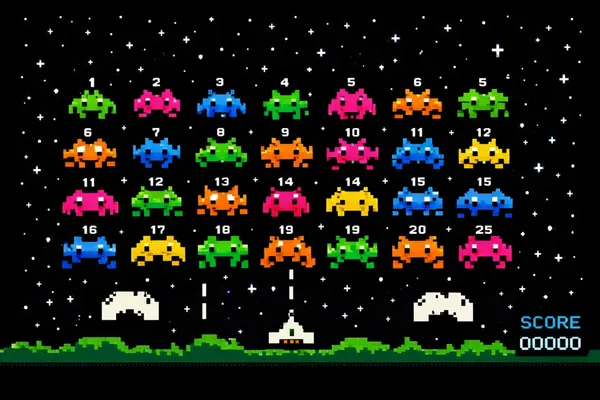
- Later 1970s - colour screens spread, bringing maze-chase and fixed-shooter games with them.
- Around 1980 - vector-line displays had their moment.
- Mid-1980s - scrolling platformers and one-on-one fighting games set the pace.
Those were the titles that became cultural touchstones and remain instantly recognisable by their gameplay even today. Arcades were not a niche hobby. They were a mainstream social gathering place, and for most of a decade they were where a whole generation went on a Friday night.
The decline came gradually through the late 1980s and 1990s, driven by the rise of powerful home consoles that could approximate the arcade experience on a television. Dedicated arcades thinned out. Many closed. But the format itself did not disappear. It evolved - moving into bars and restaurants as bartop units, shrinking in footprint, growing in capability, and eventually re-emerging as a product designed not for public revenue but for private enjoyment at home.
We watched that stretch of the history of arcade machines from inside it. JVL has been building bartop machines since 1995, and the ECHO is the eleventh generation of that line, with the generations before it marked in 1997, 1999, 2001, 2003, 2004, 2005, 2006, 2008 and 2010. The display, the electronics and the design have all changed across those eleven machines. The shape of the product has not: a compact unit, a touchscreen as the main interface, a large library in one machine, and people playing around a single screen.
How arcade machines work
At its core, every arcade machine shares the same basic architecture, whether it is a vintage upright from 1982 or a modern bartop sitting on your home bar. There are four parts: a display, a control interface, a computing system that runs the game, and a housing that holds it all together.
| Part | Classic machine | Modern machine |
|---|---|---|
| Display | CRT - heavy, curved, vivid, warm glow | LCD, often high-definition widescreen - lighter, sharper, more durable |
| Controls | Mechanical joysticks and buttons; also trackballs, spinners, wheels, light guns | Touchscreen on some units - responsive, with no mechanical controls to wear out |
| Game system | One dedicated circuit board, one game per board | Digital platform holding dozens or hundreds of games in a menu |
| Housing | Upright cabinet, five to six feet tall, well over a hundred pounds | Bartop unit compact enough to sit on a counter or bar surface |
The display is where the action happens. Classic machines used cathode ray tubes (CRTs) - heavy, curved, vivid screens with a distinctive warm glow that many players still associate with the arcade experience. Modern machines have shifted to LCD panels: lighter, sharper, and far more durable over time. Some contemporary units use high-definition widescreen displays that would have been unimaginable in the golden age.
The controls are what make an arcade machine feel different from playing on a phone or a laptop. Traditional machines relied on mechanical joysticks and buttons - tactile, clicky, and satisfying under your fingers. Other formats introduced trackballs, spinners, steering wheels, and light guns. Today's machines may use touchscreens as the primary input - responsive, with no perceptible lag, and with no mechanical joysticks or buttons to wear out.
The game system is the brain. In a classic cabinet, this was a dedicated printed circuit board (PCB) - one board, one game. If the venue wanted a new title, they replaced the board or bought a new machine entirely. Modern arcade machines have moved to digital platforms that store dozens or hundreds of games internally, ready to play from a menu. No cartridges, no discs, no downloads.
The housing ties it together. A full-size upright cabinet stands five to six feet tall and weighs well over a hundred pounds. A bartop unit, by contrast, is compact enough to sit on a counter or bar surface. The housing is not just structural - it shapes the entire experience. The angle of the screen, the height of the controls, the quality of the speakers, the weight and stability of the unit all determine whether playing feels immersive or flimsy.
Types of arcade machines
Not all arcade machines look alike or serve the same purpose. The format has branched into several distinct types over the decades, each with its own character and ideal setting.
Upright cabinets
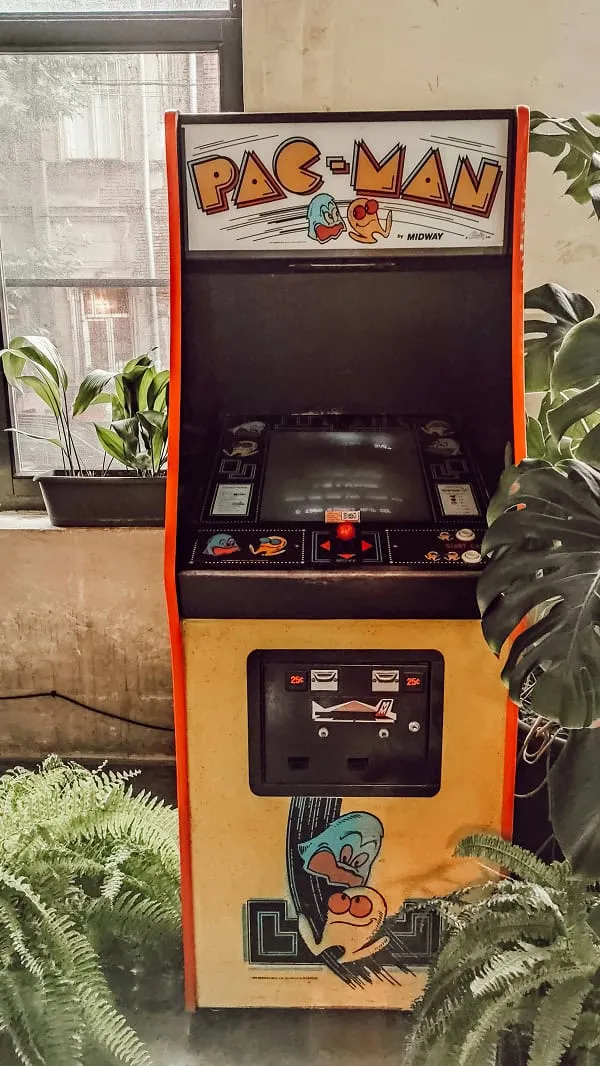
The upright cabinet is the image most people picture when they hear "arcade machine." A tall, freestanding unit with a vertical screen, a control panel at waist height, and artwork covering the sides and marquee. These are the machines that lined the walls of dedicated arcades during the golden age. They command attention, take up significant floor space, and deliver the most iconic visual presence of any arcade format.
Vintage uprights in good condition are collectible today, though they require maintenance, space, and often electrical work. Modern reproductions exist, ranging from inexpensive miniatures to full-scale replicas with updated internals.
Cocktail and table machines
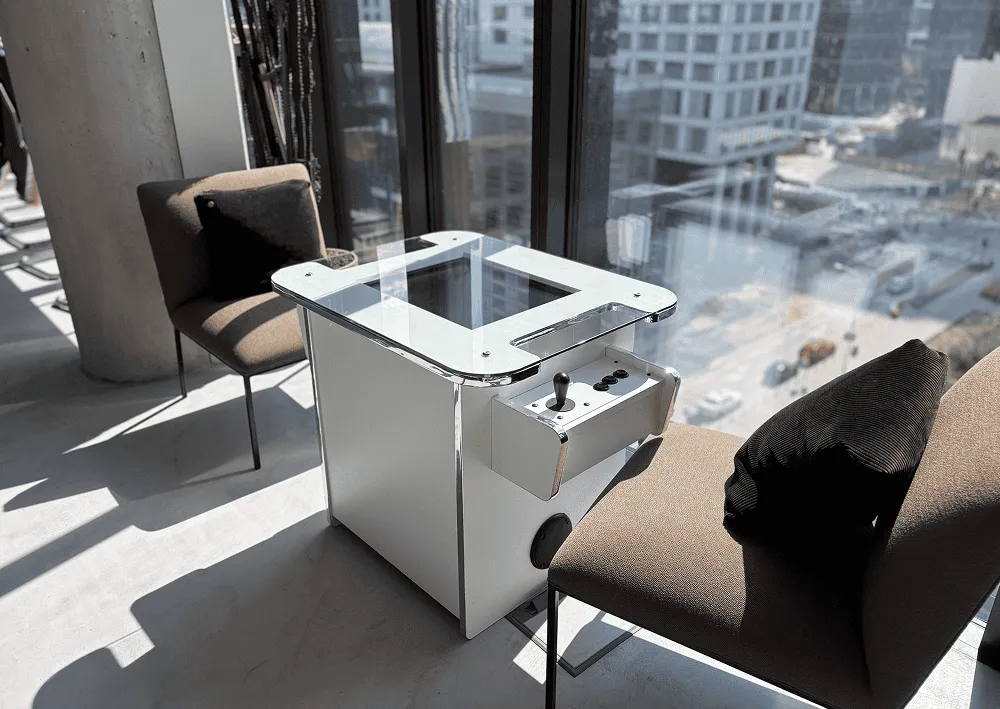
Cocktail-style arcade machines mount the screen horizontally under a glass or acrylic top, with controls on opposite ends so two players sit across from each other. Popular in bars and restaurants during the early 1980s, these machines doubled as furniture - you could set a drink on them between rounds. The format is less common today, but it occupies an interesting middle ground between a game and a piece of functional furniture.
Bartop arcades
A bartop arcade is a compact machine designed to sit on a counter, bar surface, or table rather than stand on the floor. The format has deep roots in bars and pubs, where full-size uprights would take up too much space. A good bartop delivers the same core experience - display, controls, sound, and a curated game library - in a much smaller footprint. It fits beside the bottles on a home bar or in the corner of a basement lounge.
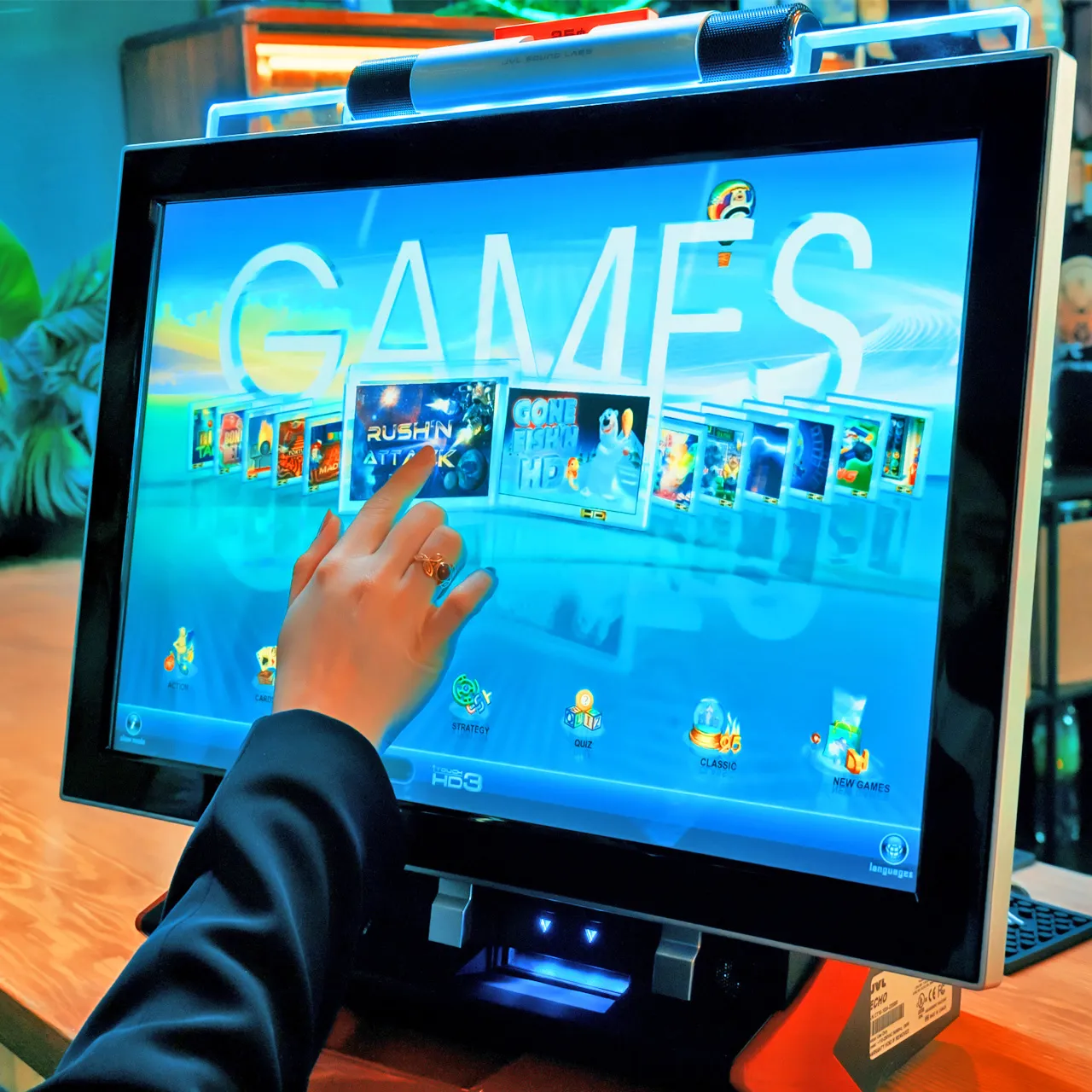
This is also where the format has seen its most interesting modern evolution. Today's premium bartop arcades bear little resemblance to the simple countertop units of the 1990s. The JVL Echo Home, for example, is a bartop arcade built specifically for adult home environments:
- A 22-inch high-definition touchscreen
- A 25-watt four-speaker sound system with a dedicated subwoofer
- 149 built-in games spanning cards, puzzles, trivia, score chasers, and bar-sports classics
- A 360-degree swivel base, which lets players on both sides take a turn
- Fully offline play - plug it into a standard outlet and play, with no Wi-Fi, no downloads, and no accounts to create
JVL has been building bartop arcade machines for over 30 years, and their bartops have a proven history in RePlay Magazine's Players' Choice rankings, including the VORTEX being named a 2006 Players' Choice.[5] The Echo Home is the current home-focused expression of that lineage, designed in Canada and made in the USA. At 15 by 19.5 by 18.5 inches, it is sized for the kinds of spaces where adults actually spend their downtime.
Pinball machines
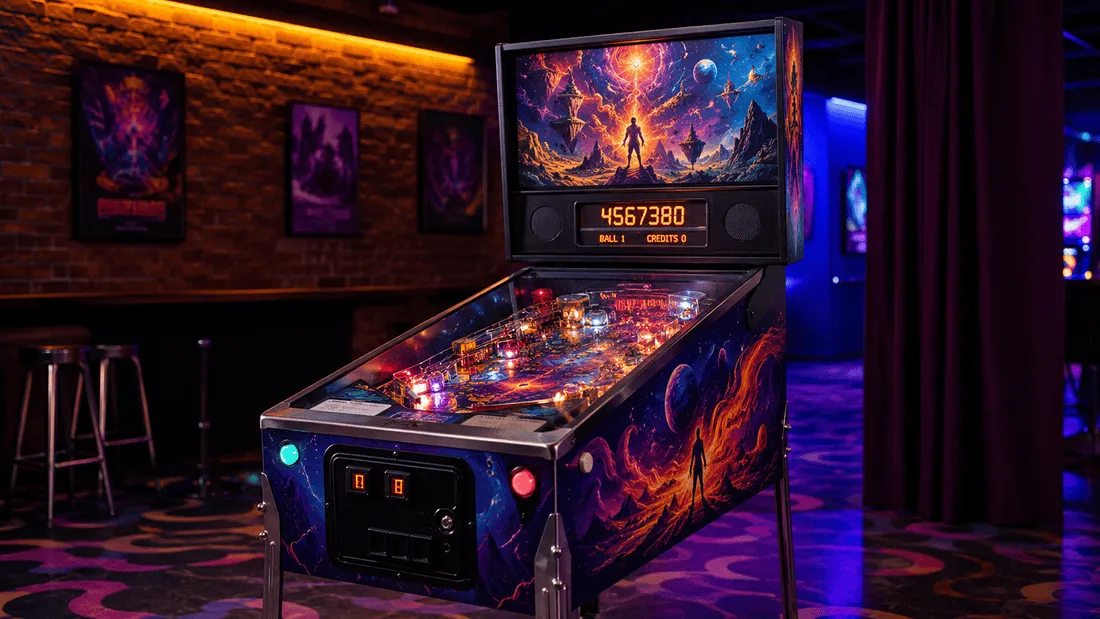
Pinball machines are technically a separate category - electromechanical rather than purely video-based - but they share shelf space in the broader arcade machine family. A steel ball, a pair of flippers, a sloped playfield full of bumpers and targets. Pinball predates video arcade machines by decades, and devoted collectors still seek out vintage tables. Modern pinball machines remain in production, though they are large, heavy, and typically start at a higher price point than most video arcade formats.[4]
Multi-game and all-in-one machines
One of the biggest shifts in the modern arcade market is the move from single-game machines to multi-game units. Where a classic cabinet played one title and one title only, today's all-in-one arcade machines store entire libraries internally. You turn the machine on, browse a menu, and pick a game. No swapping cartridges, no separate purchases.
One cabinet, one game. One modern bartop, a whole menu. That is the single biggest change in how these machines are bought and lived with.
This format is especially well suited to home use, where variety matters and space is limited. A single compact unit can offer card games, puzzles, trivia, sports simulations, and action titles - enough range to hold the interest of different players on different evenings without cluttering a room with multiple machines.
Retro arcade machines - originals, restorations, and retro-styled modern units
"Retro arcade" covers two very different purchases, and confusing them is how people end up disappointed. A genuinely retro machine is an original - a cabinet built in the era it looks like, with the hardware of that era still inside it. A retro-styled machine is new: modern display, modern electronics, modern build, made to deliver the feeling of that era without the age.
Both are honest products. They simply ask different things of the owner, and the difference shows up in upkeep, in how hard the machine is to find, and in how it behaves once it is in a real room.
| Upkeep | Availability | Home suitability | |
|---|---|---|---|
| Original vintage cabinet | Highest - a CRT, mechanical controls and decades-old boards need periodic service | Hardest - collectors, auctions and specialist dealers | Wants floor space, a power plan and someone willing to maintain it |
| Restored vintage cabinet | Lower at first, but the parts inside are still period parts | Limited - depends entirely on who restored what | Looks its best, but is still large and still heavy |
| Modern retro-styled unit | Lowest - current components, current parts, usually a manufacturer warranty | Easiest - bought new from the maker or a retailer | Designed for the room from the start; bartop sizes fit a counter |
Collecting or restoring a vintage cabinet
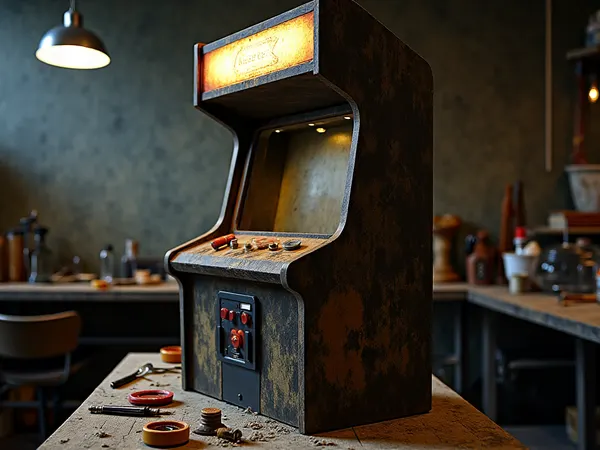
Buying an original is closer to buying a classic car than buying an appliance. The pleasure is partly in the object itself - the artwork, the CRT glow, the exact resistance of a worn joystick - and partly in keeping it alive.
That keeping-alive is real work. Tubes dim and fail, control parts wear through, boards drift out of spec, and the people who can fix all three are a small trade. Original cabinets also arrive as they arrive: what you find is what somebody happens to be selling that month.
If that sounds like a hobby rather than a chore, an original is the only thing that will satisfy you. Nothing modern reproduces the exact object.
Buying a modern machine built in the retro spirit
The other route is a new machine that carries the format forward rather than copying one old cabinet. You give up the artefact. You get a screen that stays bright, controls without a maintenance schedule, and a machine somebody still supports.
A modern bartop such as the JVL ECHO sits in that second column. Its 149 games are JVL's own titles rather than licensed classics. The appeal is the style of play - score chasers, card games, puzzles, trivia, bar-sports classics - and not a list of names you remember from 1983. That is worth knowing before you buy, because some retro-styled machines are sold on the promise of specific old titles and some, like this one, are not.
For most people putting a machine in a home bar or a basement lounge, the modern unit is the better buy. A machine that gets played every weekend beats a machine that gets admired and serviced. Choose the original only if the maintenance is part of what you want.
Arcade machines today - the home arcade revival
So what is an arcade experience in the 2020s? For a growing number of people, the gaming arcade is no longer a place you visit. It is a piece you own.
The home arcade revival has been building steadily in recent years, driven by a simple convergence. The generation that grew up feeding quarters into machines in the 1980s and 1990s now has the homes, the income, and the dedicated leisure spaces to bring the experience indoors. Home bars, finished basements, dens, lake houses, cabin retreats - these are the rooms where a well-chosen arcade machine earns a permanent spot.
The format tends to appeal to adult homeowners furnishing a bar or lounge rather than to hobbyist gamers - people who value craftsmanship, ease of ownership, and things that look right in a real living space. They want something that sparks a conversation when friends come over. Something their adult children gravitate toward during a holiday visit. Something that feels good to use on a quiet weeknight and even better during a Saturday gathering.
Modern home arcade machines have been re-engineered to meet these expectations:
- LCD and HD displays have replaced heavy CRTs.
- Touchscreen controls have joined - and in some cases replaced - mechanical joysticks, removing the maintenance burden of worn buttons and sticky sticks.
- Built-in multi-game libraries mean one machine covers an evening's worth of variety.
- Machines like the Echo Home use a plug-and-play model - no Wi-Fi required, no software downloads, no accounts to manage. The gap between unboxing and playing your first game is measured in minutes, not hours.
The quality spectrum matters here, and it is wide. At the low end, inexpensive replicas use small screens, tinny speakers, and lightweight plastic housings that feel like toys. At the higher end, premium machines are built with reinforced frames, high-fidelity sound systems, and displays sized for comfortable adult play. The difference is immediately obvious when you stand in front of one. For a homeowner furnishing a bar or basement lounge, the distinction between a novelty and a lasting piece of home entertainment is worth understanding before buying.
Coin operated games and the shift to free play at home
Coin operated games are still a category of their own, and it is worth naming the difference rather than assuming it. In a public venue, the payment hardware is the point. A coin mechanism or bill validator sits in the front of the machine, and the game exists to earn its keep a turn at a time. A machine built for a house has no such job.
It also helps to separate three things that often share a room:
- A skill-based arcade video game charges for a turn and gives back nothing but a score.
- A redemption machine pays out tickets you exchange for prizes.
- Gambling-style machines are a different category again, and the rules around them vary by place - that is a question for local authorities, not for an article like this one.
An arcade video game is not a gambling machine, whatever they may look like side by side.
The home versions of modern bartops make the split plain. The JVL Echo Home Edition ships as a free-play machine, with no bill validator and no coin acceptor. That is the design rather than an omission: a machine in somebody's basement has nobody to take money from. Every coin slot you remove is one less thing to jam, empty or explain to a guest.
If you are exploring what the format looks like today, the JVL home page is a good starting point for seeing how a modern bartop arcade fits into real adult living spaces.
Frequently asked questions
What exactly is an arcade machine?
An arcade machine is a self-contained, coin-operated gaming device that combines a display, controls, and gaming hardware in a single cabinet. Traditional machines hosted a single dedicated game; modern multi-game systems include curated libraries of dozens or hundreds of titles in one unit.
How is an arcade machine different from a gaming console?
A console requires a separate TV, controllers, and games. An arcade machine is a single integrated unit — display, controls, and software in one furniture piece. Arcade machines are designed for shared, in-person, public play; consoles for solo or 2-player play at home in front of a TV.
What are the main types of arcade machines?
Stand-up (upright) cabinets are the classic format. Bartop and countertop machines are smaller units designed for tabletops and bars. Cocktail tables are sit-down units shaped like coffee tables. Sit-down racing and shooting units are larger specialized formats. Each has its place depending on the venue and game type.
Are modern arcade machines really commercial-grade?
Premium machines – yes. The JVL ECHO HD3 uses a reinforced case and a precision-built frame, and touch controls remove the parts that wear fastest in a traditional cabinet. Every unit is individually tested before it leaves the factory - ask about build and warranty before you buy.
How much does a home arcade machine cost?
Prices vary widely, from inexpensive novelty units to premium, furniture-grade builds. The gap usually comes down to build quality, screen, sound, and how many games are included.
Is buying an arcade machine for the home actually worth it?
It depends on how much you'll use it, not nostalgia alone. A machine earns its place when played regularly and fits your space - otherwise, spend the money elsewhere.
Which type of arcade machine fits best in a small home bar or basement?
A bartop machine fits best in most homes - it sits on an existing counter or table. Upright cabinets and pinball need floor space and weight capacity most homes lack.
Are home arcade machines loud enough to disturb the rest of the house?
Not if managed – most machines have adjustable volume, so play can stay conversational or louder for a gathering. Placement matters too: open rooms carry sound further than a basement.
Can arcade machines be enjoyed by people who aren't experienced gamers?
Yes. Most home machines use simple, familiar game types - cards, puzzles, trivia, light action - that need no gaming experience, making them approachable for guests and first-time players.
Are arcade machines still relevant today?
Yes, but the format has changed: public coin-op arcades have declined, but barcades, family entertainment centers, and home arcade ownership are all growing. The core appeal of arcade-style play — fast, social, skill-based, accessible to all ages — has never gone away. It just lives in new places.
Sources
5 sourcesShow 2 moreShow less